Wednesday, May 17, 2017

Yom Yom

I’m back.  More on that later.  
Right now I am sitting with my window open and the residual smell of campfire is wafting in.  It is L’ag Ba’omer.  Sort of. Technically yesterday was L’ag Ba’Omer but the city? country? Rabbinate? decided to postpone it a day because they did not want the preparations to happen on Shabbat.  Something like that.  But I am jumping ahead.
Since we have last been in touch, there have been some very special days here.  I had never been here for Yom Hazikaron or Yom Ha’Atzmaut but Seth has.  Yom Hazikaron started the night of Sunday, April 30.  For those of you who do not know, Yom Hazikaron is Israel’s Memorial Day which they follow immediately with Independence Day, Yom Ha’Atzmaut.  It would be like if the United States observed Memorial Day on July 3 and went right into July 4.  
The connection of the two days makes sense (as would be the case in the US as well) since no one here could ever disconnect the creation and survival of this country without the sacrifices that were made for it to happen.  Israel keeps track of every single person who has died in battle or by acts of terrorism since the founding of the state and as of this Yom Hazikaron that number is 23,544.  They count to the person.  It is a hard day and beautifully observed here.  
I wanted to make sure we did something worthwhile and we were very lucky to attend some special events.  That night Seth, Zoe and I went to a tekes and program that Nefesh B’Nefesh was sponsoring at the Jerusalem Cinemateque.  Hannah and Elana Greenbaum met us there.
First of all, you need to know about the word, “tekes.” Tekes means ceremony in Hebrew and Israelis are obsessed with them.  They are always up for a tekes.  Zoe has them at school all the time.  The army has them as a way of marking the soldiers’ training (remember Max Kresch’s tekes in the beginning of our year?) and then there are the national holidays where you can go from tekes to tekes.  For Yom Hazikaron, communities, shuls, schools, organizations and anyone else you can imagine puts together a tekes.  Some people attend big ones, and others go to ones organized right in their neighborhood.
The Nefesh b’Nefesh program started with a tekes timed to end in time for us to hear the siren that goes off at 8:00.  It was an incredibly sad half an hour filled with profiles of soldiers who made Aliyah and died fighting for Israel. One of the soldiers featured was named Alex Singer and his family was there.  They showed his artwork and read his poetry.  Actually, I heard more poetry read over that 24 hours than I think I have ever heard anywhere.  Israeli’s love their poetry and poets and I heard Natan Alterman’s poem, The Silver Platter, several times.  It is famous, although, if I knew it, I forgot it.  Here it is with some background.  Some people have described it as the Israeli Gettysburg Address.
At 8:00 the siren blares for two minutes throughout the country and everyone stands at attention.  (A second two-minute siren is sounded the [next] morning at 11.)
And then we were in for a treat.  NBN was showing The Prime Ministers movie, part 1.  It is based on the wonderful book written by Yehuda Avner who worked for most of the Israeli prime ministers.  Avner, a Bnei Akiva recruit, left Manchester, England in 1947 at the age of 17 in the expectation of draining swamps but ended up fighting a war practically from the minute the boat landed in Haifa.  So he was here from the beginning and an articulate English speaker and writer.  (In fact, his role in the beginning with the prime ministers was as their aid with all communication in English.)  
We were lucky enough to have his daughter, Yael Michaeli, introduce the movie and speak a bit about her father.  She read passages from his journal and letters that the family has from his arrival in Palestine in 1947 until after Independence was declared.  As you can imagine, Avner was a great witness to history even at such a young age.  And the movie offers a substantial dose of history that goes down so easily because Avner is such a good guide.
I really immersed myself in history for these two days.  Feeling bereft of knowledge, I started reading Daniel Gordis’, Concise History of Israel in preparation and I ended up learning a lot and enjoying it.  It is an easy read and does not go into anything too in depth but if you want the basics, it gets the job done.
The next morning, Seth and Zoe both had school in the morning but were let out early for the holiday.  Seth and I chose to go with Pardes to Har Herzl in the afternoon where David Bernstein, the Dean of Studies, was leading us in observance of the day.  Again, I had never been to Har Herzl, but Seth had been many times, especially when accompanying the Hillel 8th Grade trip, and sure enough, we ran into Hillel’s 8th grade while we were there. Har Herzl is the location of the national cemetery where national leaders (yes, including Herzl) and fallen soldiers are buried.  On Yom Hazikaron it is filled with visiting family and friends and it feels like the whole country is there paying tribute.
Hannah chose to go on her own in the morning.  Zoe chose to go with a few friends straight from school, arriving in time for a tekes honoring civilians killed in war and terrorism where, among others, Bibi was speaking.  David Bernstein gave us much history and took us through chronologically.  Of course, it is a solemn place and it is painful to see all the families who are sitting by graves.  There are people who bring instruments and sing.  There was one group who came to sing whom we saw at Chana Senesh’s grave.  There was a funeral taking place accompanied by a 21 gun salute which was on loudspeaker and emotionally painful to listen to.  We did not make it all the way to the top where the prime ministers and Herzl are buried because it was closed off for the national tekes that night.
It is sad that visiting here is such a great way to learn about the country.
We returned home to get ready for the transition from sadness to joy.  Eliana and another of Hannah’s friends, Tali, came in from Givat Shmuel, and were staying with us. And we barely had time to get to Ramban Synagogue for another tekes and holiday praying. It was still Yom Hazikaron and only with davening and sundown did it end.
I left my people at shul and made my way to the Kashuk’s where we were invited to a Yom Ha’atzmaut BBQ.  When I got there, there was a group watching the national tekes (yes, another one) taking place on Har Herzl that transitions one yom to another.  This includes a torch lighting ceremony that is a big deal here; there are twelve torches – one for each tribe – and it is a big honor to be chosen to light one.  This year’s chosen included Rabbanit Henkin whose son and daughter in law were killed in a terrorist attack about a year ago but she is best known as the founder of Nishmat, the seminary where Hannah studied here.  She lit her torch in honor of all the women who study torah.  Here is the moment and the translation.  You can see what the tekes looks like.   She is an extremely brilliant woman and this was a powerful moment.
The theme of this year’s tekes was Jerusalem in honor of 50 years of reunification so all the torch lighters had a Jerusalem connection. The crowd I was with knew a couple of the other torch bearers, including Dr. Ahmed Eid, an Arab surgeon who runs the Department of Surgery at Hadassah Hospital, and a blind immigrant from India who studies where Nechama Kashuk volunteers.  This year was the first year that non-Israeli’s got to light torches and it was two Americans who shared the honor:  Michael Steinhardt, who co-founded Taglit-Birthright Israel and Rabbi Marvin Hier, the founder of the Simon Wiesenthal Center in the US.
And then the pomp and circumstance was followed by some Las Vegas glam combined with military shtick and Yom Haatzmaut had begun.
After the BBQ our group made our way to the center of town where the party was well underway.  This night is like New Year’s Eve:  fireworks, dancing, music, silly string, funny hats, Eliana hat.jpgzoe hat.jpgdrinking, the whole nine yards.  We went to Kikar Safra (Safra Square) which is the seat of the Jerusalem municipality and feels a bit like an abandoned Roman ruin.  Here is the Korelitz clan. Family at Safra Square.jpg  Here is when we ran into Talya Kresch.  with Tal Kresch.jpg
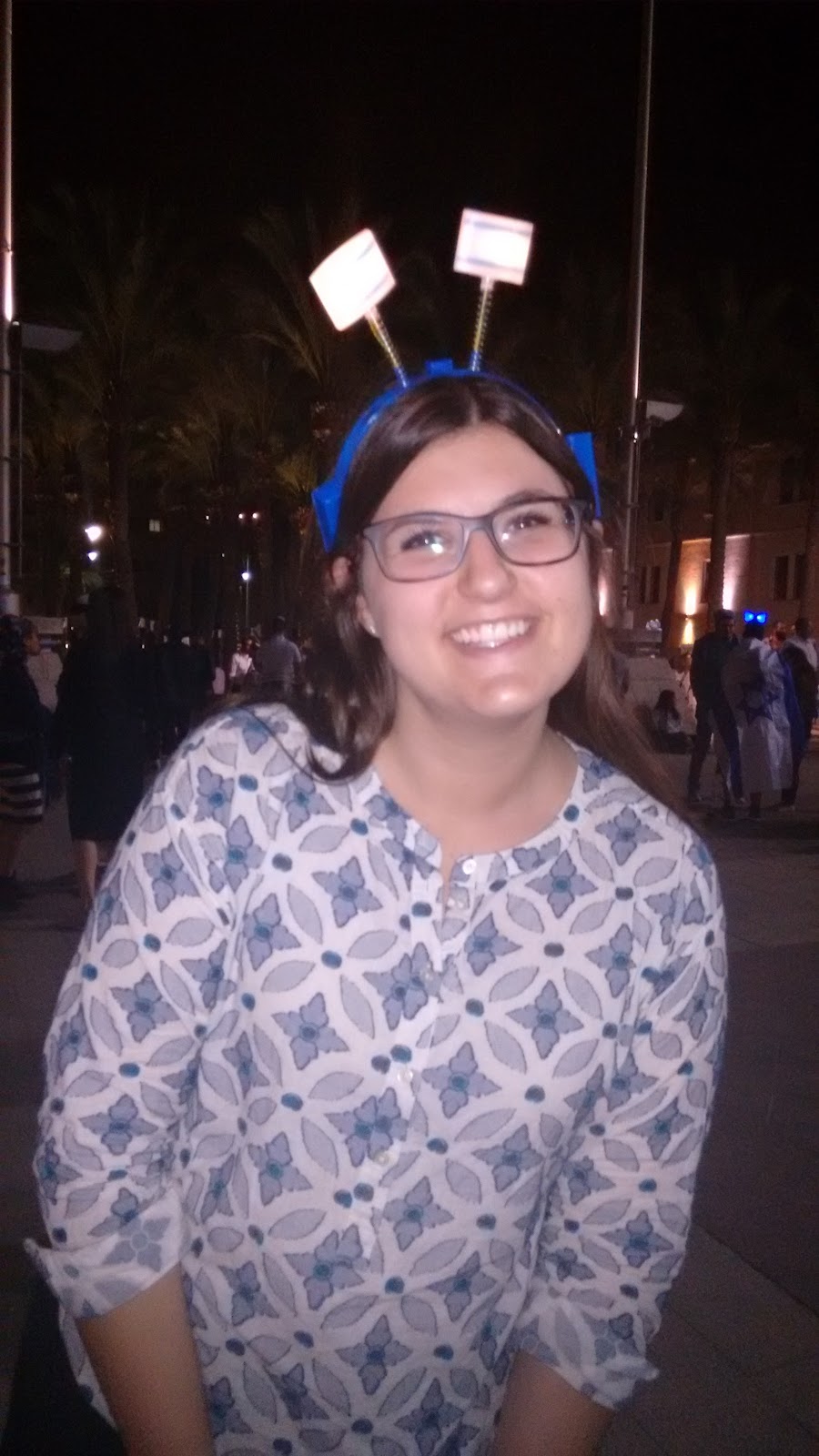
The girls went off to do their own dancing thing in the square and Seth and I enjoyed the crowd.  It was fascinating.  Yoram Gaon, who earlier that night received the honor of lighting a torch at the national tekes, was performing.  Picture an old guy, sort of like Tom Jones, singing old corny national songs.  But guess what?  They loved him!  Here were all these 20 somethings, dancing and singing at the top of their voices and approving with delight his song choices.  And it was not just because they were drinking.  First of all, Seth and I were saying that there is no national songbook in the US.  Could you get a multigenerational crowd together in the US and have everyone singing and dancing along?  Of course not.  Besides pop/rock songs, we do not share music in common.  These were national songs.  This Land is Your Land?  America the Beautiful? What?  Do you even know the words?  These people knew every word to dozens of songs.  They liked each one more than the last one.  And many of them broke out into Israeli dancing.  Here is a video from early in the night which does not fully capture the fun.


[Apologies. Too uneducated and too lazy to get this facing the right direction. Seth] There were celebrations like this all over Jerusalem.  Fireworks went off at midnight.  And soon after, Seth and I started the walk home.
If Yom Haatzmaut at night is like New Year’s Eve, the day really is like the 4th of July.  Parks, BBQ’s, etc.  We packed a picnic and the 4 of us headed to Independence Park to hang with the natives.  Just families of all generations having fun.  There was a flyover but, in general, it was pretty mellow.
Three of us went in search of some history after the picnic because we had read that Eshkol House was open and free for the day.  Levi Eshkol was the prime minister during the Six Day War and his official residence is now a museum and education center. We were all into Eshkol following the movie from two nights previous. We found the house, a beautiful international style building on a lovely street in Rehavia, but they were sold out for the day.  We hope to get back.
It was a meaningful and fun two days and we felt that we had been a part of the observances and celebrations.  So, once again, if you are looking for a holiday to spend in Israel, really, why should it not be these two?  And really, where else can they be observed?
My week of Israeli history continued the following Sunday night when I went to an evening with Natan Sharansky.  I could not pass up an opportunity to see a real live hero while I was here.  Hannah is an old hat at seeing him, when working for Nefesh B’Nefesh and once just on the street. But this was my first time in the flesh.  The evening was sponsored by the Times of Israel and Nefesh B’Nefesh and was structured as a casual interview with a Times reporter.  It was a great night.  He was so interesting and has an amazing view of life and the world and has such perspective on politics and history.  I loved hearing what he had to say including how he told Breshnev jokes when he was being interrogated by KGB thugs.  (They had to fight smiling by the way.)  There are a few more interviews in this series that I hope to get to.
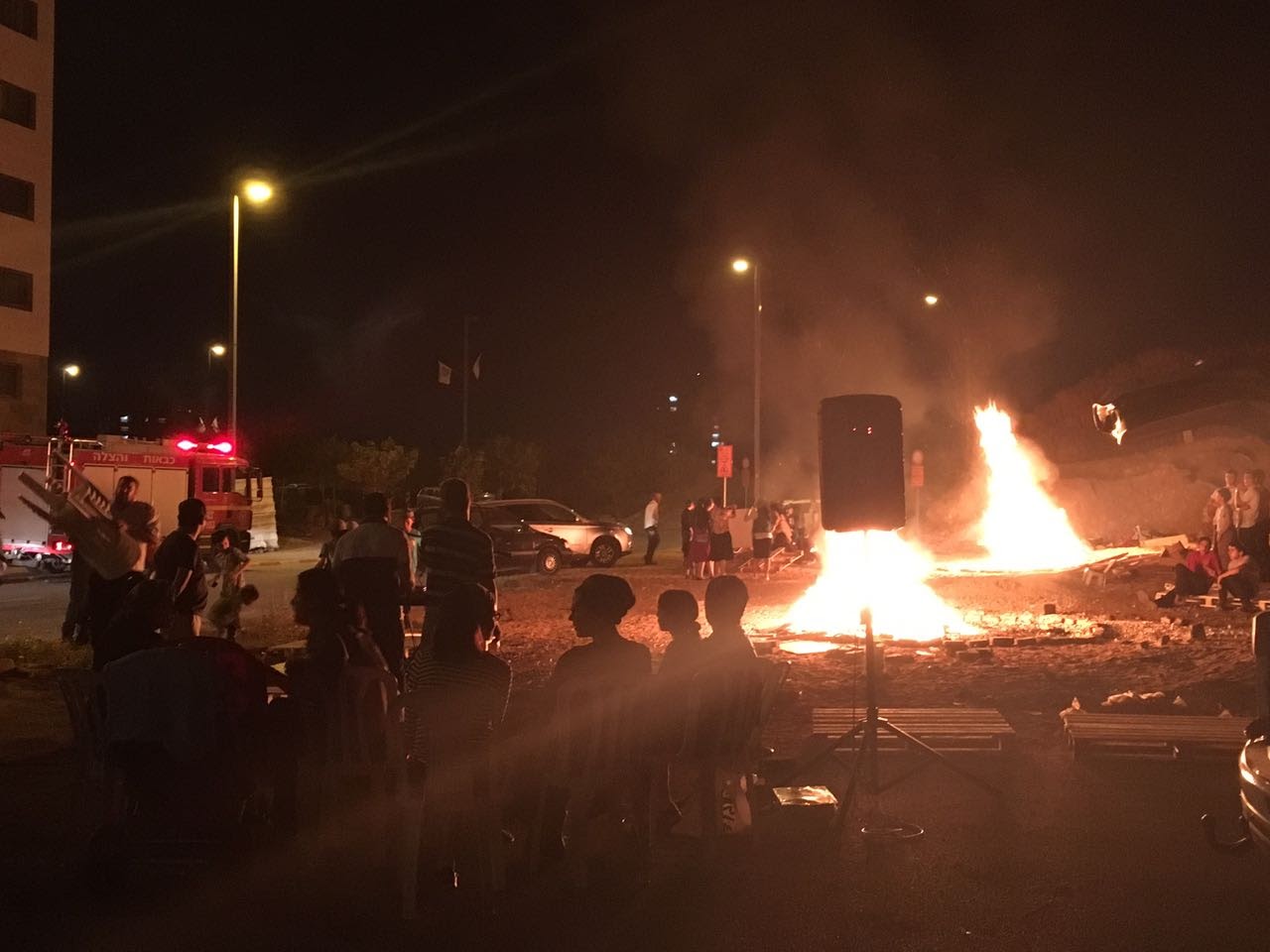
And this week I started my ulpan again.  Yay, I really need it.  And as I mentioned, we had Lag Ba’Omer here.  In case you are looking for a holiday to celebrate here, do not pick Lag Ba’Omer.  I had no idea how much anxiety I would suffer just knowing that open fires were burning throughout the land.  Who knew that I had arson issues?  Maybe everyone has arson issues.  Anyway, I went to a movie with Allison and by the time I walked home I smelled of a camp fire as the city reeked of smoke.  Glad to have that one over.  Here is a picture Hannah sent us of some arson fun in her street in Givat Shmuel.  (Not a riot, despite appearances.)Givat Shmuel Lag BOmer.jpg
And now I return to my opening greeting.  I am writing because Seth is in the States.  For those who have not heard, Seth has been offered and accepted the job of Director of Jewish Studies at the Frankel Jewish Academy and is there doing some work.  It is very exciting.  We did keep telling you all that we were coming back.  
[Quick note from Seth:  The first thing I did when I got here was go to Trader Joes, of course.  Just in case I had any doubts that I was back in the States, the three people who in quick succession apologized for walking in front of me while I was checking out the cereals cleared it up for me.  It threw me a little, since the notion that even a clerk would apologize for something like that, let alone a fellow customer, is decidedly not Israeli !)
For now, Zoe and I tough it out alone.  Next week, the final, and this year at least, the most intense Yom -- Yom Yerushalayim which includes a visit from the President of the United States.  I, for one, am holding my breath.
Until then.

What happens in Israel...

Sunday, April 30, 2017

From Here to There. Random thoughts on transportation in Israel


Driving
You probably casually skipped over references in the last couple of blogs about our driving here or driving there.  But for us, this was a big deal ! We’ve always been a little bit afraid of driving here, and in all our visits over the years we’ve never driven.  Not once. This entire year has been no exception.  Trains, buses, cabs aplenty, but driving ourselves?  In part, there’s just been no need. Pardes is a five-minute walk for Seth, we have two grocery stores not much further than that, Zoe has a bus she catches around the corner to get to Horev.  When Sheryl had big trips entailing a lot of schlepping she imposed on Allison to give her a lift.  

But Pesah plans entailed a lot of moving around, and anyway we thought it was time to bite the bullet.  Geez, what were we worrying about?!  The hardest part was all the paperwork for renting the car. (Compounded, of course, by our fears that our limited Hebrew was going to cause us to miss some important detail.)  After that, it was all smooth sailing, if you don’t mind the metaphor.  

Random addition:  We rented from a small, independent agency the Pollocks recommended, but you’ve got to tip your hat to Avis in Israel.  (Sorry, if you aren’t familiar with Game of Thrones this won’t resonate.)


Anyway, back on the road.  We used our fancy 21st century apps (Waves for directions and Pango for parking), didn’t hit any serious hol hamoed traffic (a lot of Israelis are on the road at this time of year but it wasn’t anywhere near what we feared) and only had to use our horn a couple of times.  Although we clearly outed ourselves as foreigners when we did give our horn a short press. There’s basically no such thing in Israel as a short honk.  Five to ten seconds seems to be the average, and Israelis tend to be a little trigger happy.  People will honk even when there seems to be no possible, logical reason to do so.  You can be sitting at a ramzor (traffic light - a combination of two words: remez/hint and or/light. So clever!)  and somebody will honk at you if you are letting a group of people finish crossing in front of you, or frequently just in anticipation of the light changing.  Sometimes not even that.  Israelis don’t really need an excuse to use their horns.  It’s not quite as natural as breathing, but pretty close.

We still love the fact that we’ve been able to do without a car the entire year, but we feel proud of ourselves for finally joining the ranks of Israeli drivers.  Of course, like everything else this year we’re just ‘fakers’ and didn’t have to deal with the worst of driving culture in Israel.  E.g. - some day maybe Hannah will share with you the travails of getting a driver’s license here.

You definitely see fewer people driving on Shabbat than other days (though Seth seems to think that there are more drivers in Jerusalem on Shabbat than there were let’s say 20-30 years ago. Probably just more drivers, period).  What you do notice more on Shabbat than other days are student drivers.  Since the roads are less crowded it seems to be an ideal day for those not observing Shabbat to take lessons.  Any time you see a car with a ל sign on the roof (Lamed, for the first letter of the Hebrew word “learner”) you know it’s a student driver.  Seth’s heard there’s an expression for when someone is sort of meandering thoughtlessly in front of you on the sidewalk “hey, where’s your lamed?!” .  Never actually heard anyone use it, but doesn’t mean there haven’t been countless times when we’ve wanted to use it ourselves.  

The Bus Drivers
These guys get a bad rap.  I do not know why.  They can be a little rude but not really.  First of all, as a recent Eged bus line “Sick out” revealed, they are ridiculously underpaid.  Also, they have a hard job driving around all the time and they get no training.  Both of our girls have had the experience of having to give directions to the drivers because the dispatcher evidently sometimes just tell the drivers to head out on a new route without bothering telling them what to do. They also have to take payment for bus passes, reload the RavKav (bus pass) and make change while driving which is very difficult.  (And sometimes a little dangerous feeling.)

Despite Hannah’s and Zoe’s evidence to the contrary, Sheryl has had nothing but success every time she asked for help.  (Seth’s record is 2 for 4).  Still, the drivers have been very nice and they tend to be protective of people who do not know where they are going (thus Sheryl's success.)  The drivers usually tell the lost souls to sit by them and they will take care of them.  That invisible wall between the driver and the passengers does not really exist much here.  First of all, drivers play the radio a lot -- whatever they want and really loudly sometimes. Very often, people hang out and talk to the drivers in the entrance way of the bus which looks dangerous to me but they don’t seem to care.  And at least one driver we saw at Purim had decorated the entire area around his seat and entrance in honor of the holiday.  No issues with the bus drivers.

Taxi Drivers
Ditto for the cab drivers.  We have had a cab driver give us a free ride (I think we mentioned this in an early blog when we went to Zoe’s school.) He literally would not take our money. They are a chatty group and Sheryl always likes to talk to them because she gets to find out stuff about the country.  We don’t use cabs much to save money but when we do we use GETT, which is like Uber, but uses taxi drivers and is actually an Israeli company.  (Helpful tip: make sure you have GETT if you are going to the Israel Museum. We’ve been stuck there more than one evening unable to get a cab, even after big programs.)  Sheryl still tips cab drivers which people tell her she shouldn’t do but she can’t help it.  Old American habits die hard.

Jeff and Debbie Devries told us a nice cab driver story when they came to us for Shabbat lunch a while back.  They got a little lost going to the shul and ended up walking too far.  They could tell they were lost but not sure where to go so they figured they would ask a cab driver.  This cab driver offered to take them there for free (they were close to their destination) and, of course, Debbie and Jeff said no thank you and when the driver realized they could not drive because it was Shabbat he proceeded to follow them to make sure they got to where they were going.  People do that kind of stuff here all of the time.

One of the peculiar habits of cabbing in Israel is that if you are traveling alone, the default seems to be be to get in the front seat next to the driver.  If you tried this in NY, you would probably get a strange look -- or worse -- from the cabbie.  When we go anywhere as a family Seth always takes the front seat, but after two cabbies in a row yelled at him a few years ago for “slamming” the door  (ever since a favorite family anecdote), he’s very careful to close taxi doors ever so gingerly.

Mass Transit
The mass transit in Israel is pretty good, and getting better.  The new fast train between Tel Aviv and Jerusalem (see here) is scheduled to open next year, ahead of schedule.  It will be electric (good for the environment), fast (about 30 minutes instead of the hour+ for an average car trip), and popular (expected ridership close to 100,000 per day).  A few more years down the road Tel Aviv will open its first light rail system.  (Here’s an article, and a map of the final plan.)

Closer to home (Jerusalem), there was a lot of uproar earlier in the year when plans were announced for the expansion of Jerusalem’s light rail.  As expected, the next phase will run down Emek Refaim. Residents of the German Colony neighborhood were largely unhappy about this.  Some are still trying to fight the plan, but don’t put too much stock in their chances.  Here’s the master plan for Jerusalem’s light rail, for those who are interested.


No planes within Israel which we did a few years ago, flying back and forth to Eilat for Oren Lerner’s bar mitzvah) and no bikes. Electric bicycles are quite popular here and Sheryl has been really keen to get one.  Maybe back in Detroit.  We also haven’t used scooters, which are really popular among the elementary set.  

Otherwise,
planes ☑
trains and
automobiles ☑  
We’re best buddies with Israel Katz!  (That’s the head of the משרד התחבורה והבטיחות בדרכים/Ministry of Transport and Road Safety if for some reason you didn’t know that!)

What Happens in Israel...

Friday, April 21, 2017

Plain Pesah

Pesah


We hope everyone had a great Pesah.  Ours was lovely, if somewhat low-key.  So, not a lot to report, especially since we mentioned last week about the prep.  Just a short entry to check in.


One thing I did notice: with just a small kitchen to turn over, no seder to lead, and no seders to cook for (since Sheryl usually tries to pitch in a little on that 😌), the start of Pesah seemed a little abrupt.  I didn’t feel quite in the right (or at least typical) state of mind as we headed off to shul.  It was sort of like, “oh yeah, it’s leil Seder.”


Still, it didn’t take long to get into the mood, and by the time we got to the Pollock's I was definitely looking forward to a great night.  And we were not disappointed!  The food and learning were both exactly what you would have wanted.  It was just us and the Pollocks, so everyone felt relaxed, comfortable. Zoe -- understandably -- was feeling a little unenthused at being the youngest child at age 16, so she prepared a little Torah in place of reciting the 4 Questions.  After discussing her words, though, we all joined in together to recite. And so it went all night: We read, talked, sang, laughed, learned. Things finished up at a decent hour (around 1:00 AM), and we had a short walk home.  There’s really nothing like being in Israel at an hour like that, looking around at the other groups of people walking around in the middle of the night and knowing they’re all on their way home from seders, too.


Nitzanim was crowded of course the next morning.  A lot of the regulars were away, but it’s a popular place for visitors.  The Greenbaums are among a number of families we know who daven there regularly when they are here.  We mentioned last week their hosting us for Shabbes dinner before Pesah, and I got to daven with Joseph and Avi a number of times over the Chag.  The Tefillat Tal, marking the end of the rainy season, was externally a little less solemn than at home (no kittel for the chazan) but it was recited beautifully.  For certain one of the most moving parts of my tefillah experience this year.


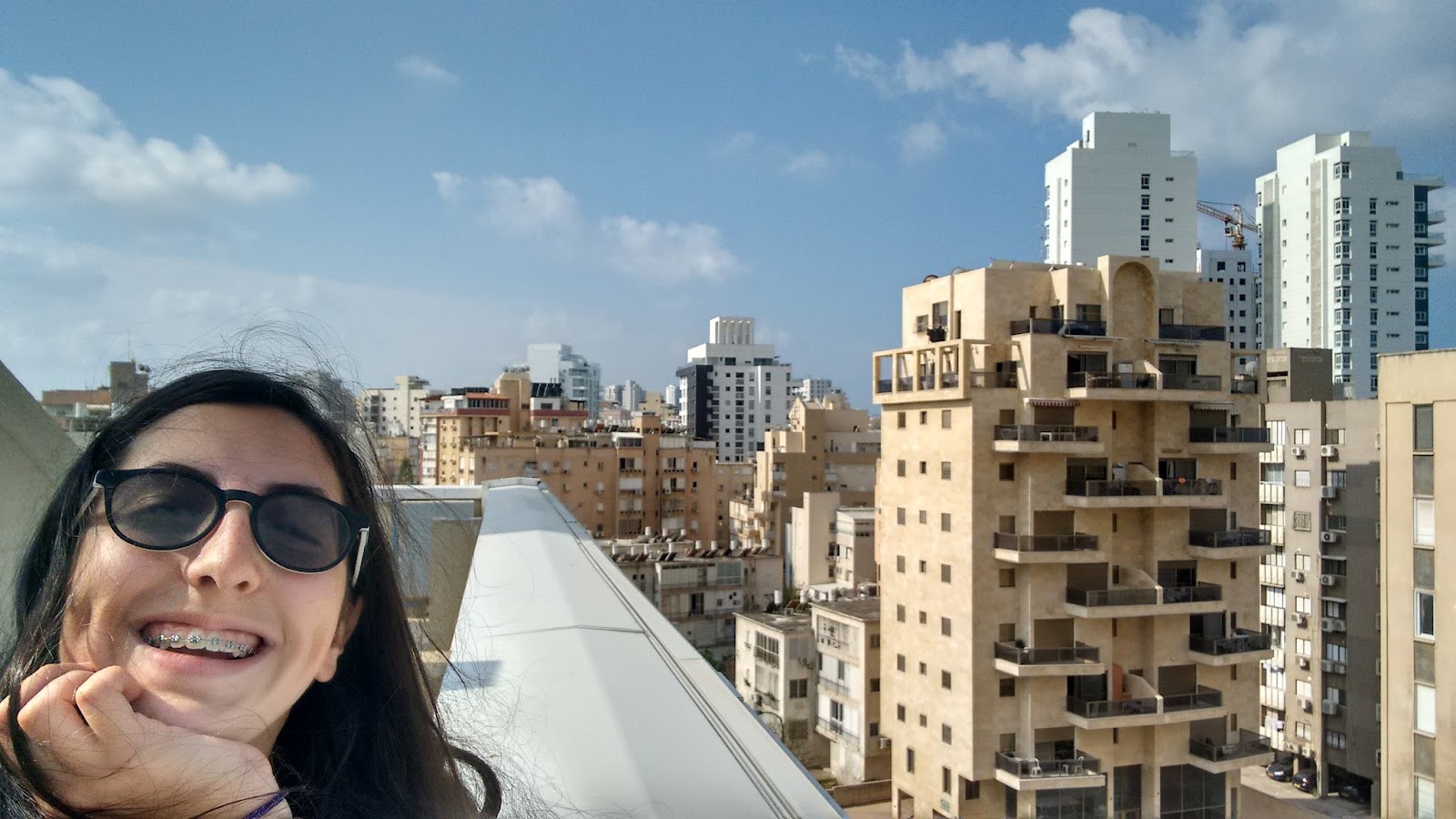
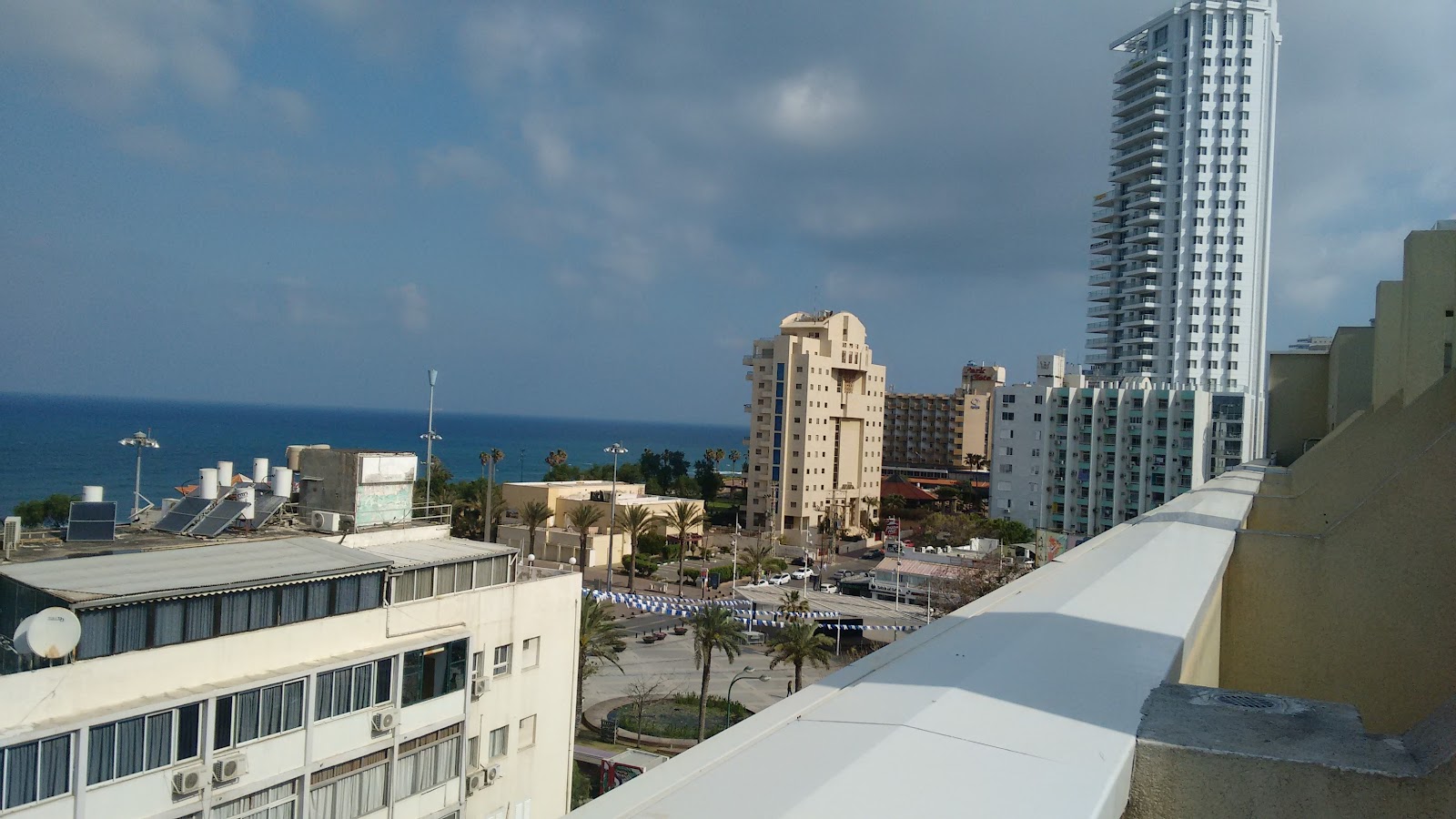
It was of course a ‘short’ hol-hamoed this year, and we didn’t do much.  We did have one big excursion, however, and that was going up to Netanya for a day.  It really felt (and looked) like Miami Beach, IMG_20170414_091743968_HDR.jpgIMG_20170414_091734227.jpgzz and abba on Netanya balcony.jpegthough Netanya has had a large influx of French Jews the last few years, which adds a different flavor.  


But it’s still Israel.  Quick insight, courtesy of Hannah:  Imagine checking into a nice hotel in Miami.  Maybe not the nicest, but a good, 3-star branch of an international chain.  Now what would you imagine would happen to two employees at reception there who were arguing loudly with each other at peak check-in time.  Fired, maybe?  Certainly reprimanded.  But in Israel no one blinked at the Netanya Leonardo when two women there yelled recriminations at each other over who was to blame for some computer problem. Just another day here.


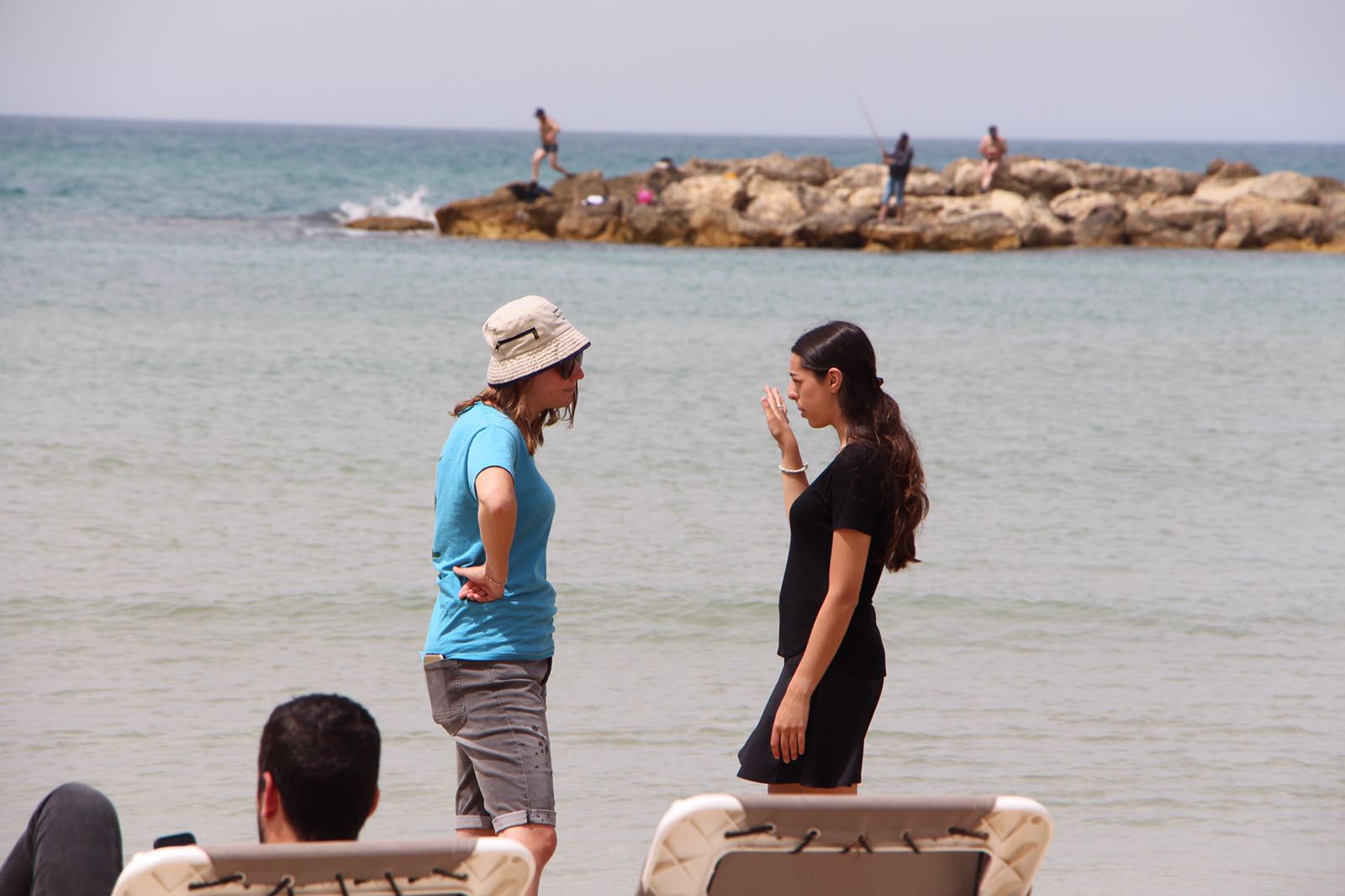
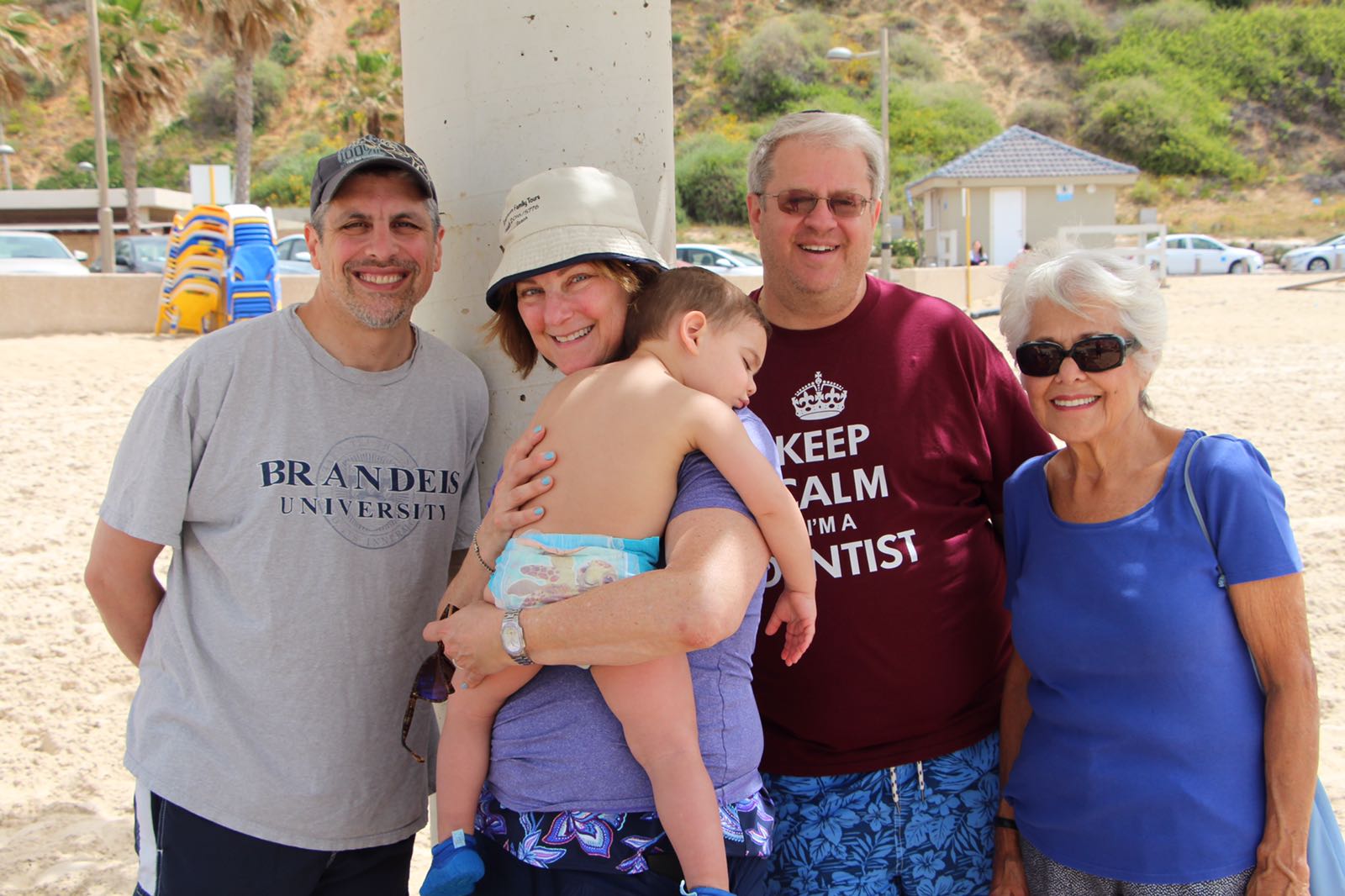
We got lucky, ‘cause the weather was calling for cool and rain, but it ended up being nice and we spent all day on the beach.  The Greenbaums were actually staying in Netanya for a few days and they walked down the beach to visit with us, which was nice.  Hannah and Elana on the beach at Netanya.jpegon the beach at Netanya with Greenbaums.jpegThe Pollocks were also there (not so unusual for them, since Benjamin’s parents have an apartment there) and we spent a few hours with them in the evening, including some Pesah pizza and then ice cream.  Hol Hamoed Pizza part two.jpeg


So that was about it for Pesah.  A couple of days back in Jerusalem just relaxing around the apartment reading and eating.  (Including Ben and Jerry’s kosher-for-Pesah.  Charoset ice cream, anyone?) IMG_20170404_155543938.jpgThen Hannah headed back home, and she, Zoe, and I all headed back to school.


We’re heading into the Yoms, so hopefully we’ll have something meaningful to share soon.  Time to start getting ready for Shabbes here.  Have a great one, everybody!

What Happens in Israel...

Monday, April 10, 2017

Petite Pre-Pesah Post

Sorry to start with bad news, but after many weeks, Sheryl is taking a break and the blog is back in my hands.  We hope to have you back to your regularly scheduled programming as soon as possible.

We’ve been trying to enjoy vacation as much as possible.  Which has been made easier by a relatively low-key pre-Pesah season. Zoe and I have been on vacation, and it’s a slow season for Sheryl with work, so we’ve had plenty of time and a leisurely pace the last week or so.  A small kitchen and having our one (!) seder hosted by the Pollocks means that Pesah Prep is all the easier.   

Which is not to say that some things don’t feel just like home -- I had to make three or four runs to the stores the last couple of days to buy new items we forgot/didn’t realize we needed.  Sheryl often comments on how ridiculous the amount of Pesah stuff we have is (a good-sized closet awaiting our return in Huntington Woods). We’re not there yet, but we were starting from scratch, so we had a few items to buy.  No problem, though; just more items to add to Hannah’s “trousseau”  when we leave this summer.

Sheryl and Zoe started the week off with a visit to "the Tayelet"  (Haas Promenade) a lovely series of walkways not to far from our house.  It’s got some of the best views of Jerusalem, 'though pictures don't really do it justice).


I was actually there a few weeks ago with a small group from Pardes.  I crashed a little field trip with a small class that was discussing the whys and hows of teaching about Israel.  The Tayelet is a great place from which to do that, because it’s connected to many, overlapping narratives about the city and Jewish history.  Avraham, David, Talmudic times, Middle Ages, Modern history (itself divisible into many aspects, not the least of which being Israeli-Arab relations): all their stories are reflected from this beautiful outlook.

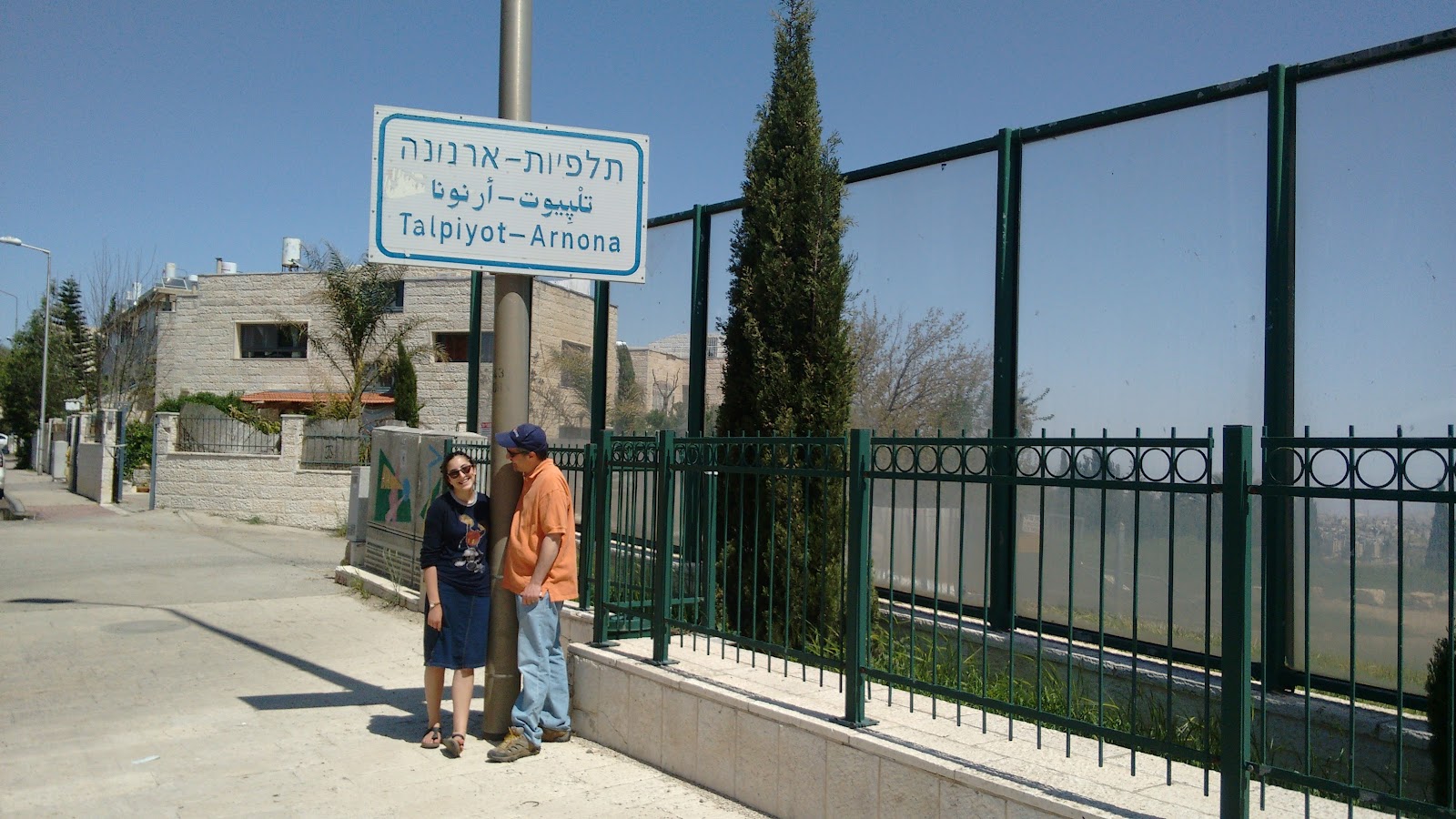
A slightly more ambitious outing was a self-guided tour we took of the Talpiot neighborhood, which borders our neighborhood of Baka. Actually, not entirely self-guided, as we were using a very nice guidebook loaned to us at the beginning of the year by my teacher/colleague/friend Susan Wall.  We saw the spot (now an apartment complex) where Jerusalem’s first airstrip stood a hundred years ago.  We also saw some of the homes of early founders of the State, including Eliezer Ben Yehudah, the “father” of modern Hebrew.  Sadly, Ben Yehudah himself never lived in this house (he died during construction) but his wife lived there for many years and so the house is still associated with him.  Today, it’s actually a hotel/hostel, though there is a visitor’s center addition on the back and evidently they sponsor some events there.  
 We Just checked it out from the outside.  

We did go in, though, when we got to S.Y. Agnon’s house.  Agnon, as I’m sure you know, is widely considered Israel’s greatest writer, and it’s only Nobel Prize winner in literature (1966).  Sheryl has actually been making her way through (in translation) his very long Only Yesterday.  Anyway, Agnon had an amazing, often turbulent life (one small tidbit he lost his library/rare book collection to a fire in 1924, and then again during the Arab riot of 1929, an obvious tragedy for a man like Agnon)  and they do a great job at this house/museum of giving you a sense of it and of his personality.   At one point, the family had a view of the Old City and Temple Mount from their rooftop (evidently part of the reason for their having chosen the spot) but the growth of the neighborhood in the intervening years has obscured that.

From there, we made our way (after a fortuitous discovery of the Talpiot branch of Lechem shel Tomer) to Ramat Rachel.  Most famous as the site of the recent Korman wedding, Ramat Rachel is also famous as being one of the first kibbutzim.  I hadn’t been there since my first Israel trip 35+ years ago, but by then it had already added tourism to agriculture as a source of income, but not yet hi-tech, which was added to the mix about 15 years ago.  The truth is we were pretty tired by the time we made it there, so we didn’t look around much.  Rested, enjoyed the views, then headed back home.
coming back from ramat rache.jpg
On the way back from Ramat Rachel


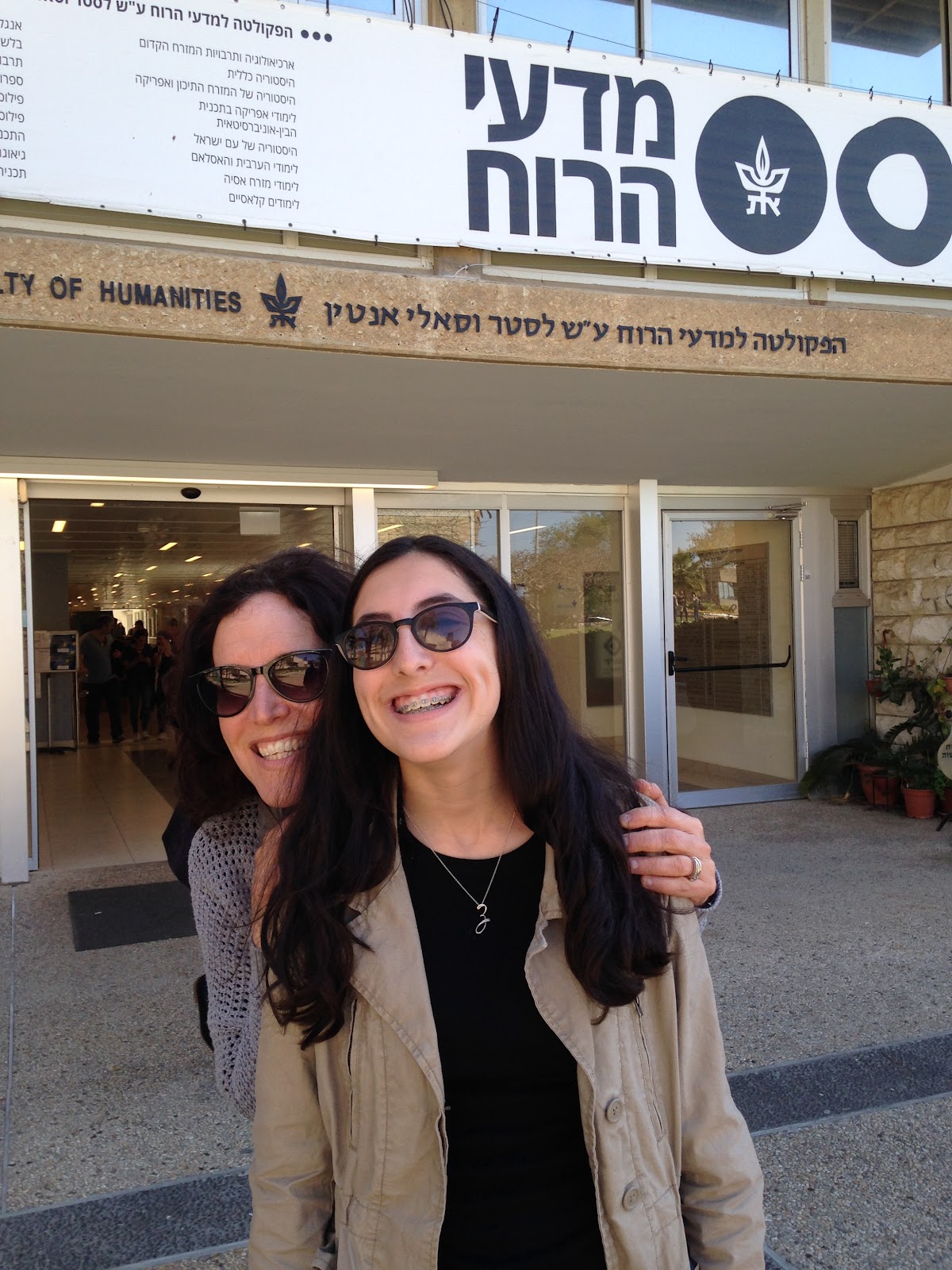
And our third recent outing was our most ambitious of them all.  We decided to drive up to Tel Aviv.  We didn’t really have plans.  We had hoped to visit Hannah at Tel Aviv University, but she said she wasn’t going to be on campus that day.  So we decided to visit the Diaspora Museum, which Zoe had never been to, and neither Sheryl nor I had visited since it was redone. The museum sits on the campus of TAU, so we figured we would combine museum-going with checking it out even if Hannah wasn’t there.
TAU.JPG
Outside one of Hannan's main buildings on campus


Visiting the museum was clearly fortuitous planning, because what did we discover upon entering but a special exhibit on Bob Dylan in honor of his 75th birthday.  (For those of you who don’t know, I am a rather large Dylan fan!)   dylan exhibit.JPG

t was very well done.  Further sign that this was meant to be was Sheryl sitting down to this fortune-telling jukebox, containing Dylan’s entire catalog.  You sit down, it picks a song at random, and it plays what is supposed to be ‘your’ Dylan song.  And what did it choose for Sheryl?  Her favorite Dylan song, “I’ll Keep it With Mine”!      
dylan jukebox.JPG
We started with that, and afterwards anything  was going to be a let down.  The new exhibit (some of it, thematically at least, is the same as the old exhibits) was actually quite enjoyable, but the the old exhibits were bizarre!  Completely unchanged in over 30 years, run down, barely lit, just sitting there on the top floor.  Hopefully they’ll get around to doing something with this space, but for now they are not doing themselves any favors by keeping it open.  Really, just creepy.  Yikes!

We took a short break in between touring to grab lunch at their Aroma Cafe, which is clearly used by museum visitors and TAU community.  After the museum we spent a few minutes walking around Hannah’s campus.  Not particularly impressive architecture, and it’s small (the entire campus could probably fit in the parking lot of OCC’s Orchard Lake parking lot) but it was a treat for us to be able to see where Hannah studies.

Of course the highlight of the day (the week.  The month?) was heading a few miles to the east to finally see Hannah’s apartment. After eight months, it was about time!  We did get slightly lost (I entered last year’s address into Waze.  Oops) but we got there pretty quickly. Only one of Hannah’s roommates was home with her, Jessica, but we had a nice visit before heading back home.

And now Pesah is about to start.  A few people in town. Including the Greenbaums, who kindly had us over for Shabbat dinner.  Their apartment is near ours, and they usually daven at Nitzanim which we’ve made home this year, so I’ve seen Joseph and Avi a few times this week.  Zoe and I enjoyed our search for chametz last night, and as I usually do, took care of the biur (burning) myself this morning.  I figured there would be random fires around town (there were

though not as many as there will be in a month for Lag B’Omer) but the city also organizes spots around town.  Not as well done as Jerry’s at YIOP of course (when I got there this morning there was just the bin and one guy with a set of matches trying to get it started),
a little later, after it got going
but as Joseph pointed out, it’s nice that the city provides for this.  Avi even found this location for us online, since the city posts the locations on its website.


OK, it’s getting late and there are still some things to do some I’m gonna run.  More Pesah later.  In the meantime, Chag Kasher V’Sameah.

What Happens in Israel...

Friday, April 7, 2017

Post-Purim, Pre-Pesah


This is my final catching up blog and I think Seth will be ready to share for a while.  As I write this, I am listening to the Gan (nursery) next door learn “Chad Gadya,” for the seder.  Living next to a nursery is a treat.
Marathon Day.  So on Friday morning, March 17 we three Korelitz’s got up at 5:30 AM for Zoe to run the 5k.  File_003 (1).jpegThere was a 5K, 10K, half and full marathon scheduled and they were starting at different times.  Zoe did not start until 7:30 but our issue was getting to the starting point.  The full marathon literally covers the entire city and so most of the roads are shut down and there is no public transportation working until after the race, so we knew we were going to have to get there on foot.  It is not that far of a walk but we wanted to leave enough time.  
So we picked up Zoe’s friend, Edya at a prearranged corner and started making our way to Gan Sacher Park.  File_002 (1).jpegThe starting point was actually somewhere on Rupin Street in front of the Knesset.  Not sure exactly, I never got that close.  As we left our apartment there were already barricades and police stationed at intersections.  The race wound past us at the end of our block so we were in the thick of the route.  And as we made our way up and I do mean UP Kovshei Katamon (a street to be mentioned later) we encountered many volunteers who would spend their day making this happen.
This was the 8th year of this event and it has swelled to 30,000 participants with 3000 international runners.  You can already sign up for next year’s race on the website, and I suggest to everyone who is a runner that you should do it if you can.  Even though I did not take part, I can tell you that Jerusalem is a spectacular place to run and a huge challenge. For those of you who have been here, you know this city is one hill after another so the running is not easy.  Allison Pollock did the half marathon for a second year and she was pretty nervous about it and she is an amazing runner: She runs overnight!  To Eilat!
The day was perfection -- that Jerusalem blue sky without a cloud and the temperature was a perfect runner’s 55 degrees.   The closer we got, the more people we joined.  By the time we got to Gan Sacher, it was packed.  The half marathon started first.  And as we were sending Zoe and Edya up to the starting line, we heard clapping and yelling and turned to see about 6 African runners wrapped in gold foil warm up capes walk through the crowd.  It was the Kenyans!  And now it felt like a real race.
Edya and Zoe befoe the race Q.jpg
Edya and Zoe, heading off to the Starting Line
We told the girls we would meet them at the end and then Seth and I tried to figure out how to do that. Finding the 5k finish line was not the easiest thing.  At one point we thought we were as close as we could get when a lovely, soft spoken police officer took pity on us and let us stand where we were not supposed to.  When you stand around with someone for half an hour, you end up talking and it turned out he was a Beduoin and was stationed there with a guard who was starting the army the next day.  The other guard was also not Jewish but I did not get his story.  Meeting Bedouins is not something that happens every day. Everybody has a story.
But then Seth and I figured it out and found where to stand.  And watching the runners cross was a blast.  Lots of kids in the 5K.  We got there in time to cheer Edya across the finish line and waited for Zoe.  And waited.  And finally, we decided that maybe she made it in before Edya so we called Zoe on her phone and she had finished but after Edya, so, somehow we were standing there when she finished and missed her.  There was a lot going on, but we still felt bad.
We met the girls back at Gan Sacher and watched the happenings going on. Here are our happy and victorious giborot (heroes in the feminine!) Edya and Zoe after the race.jpg  It is a giant party.  There was a screen showing real time images of the marathon and they showed a trio of runners outside the walls of the Old City who we figured out were the front runners.  Here is a shot of what they looked like and a couple of other pictures to give you a sense of the hills as they run around the Old City and one with the Mt. Zion and King David Hotels in the distance. marathon1 (1).pngmarathon 2 (1).pngmarathon 3 (1).png
More on the three of them later.
Then it was time to make our way home and so we left Edya behind to meet her sister and started the schlep.  On our way, we saw the half marathoners running up Ben Tzvi.  It is not a huge incline but it is a long uphill trek to the finish line.  The intersection of Herzog and Ben Tzvi is a fun spot to watch because as the runners come down Herzog, they turn onto Ben Tzvi for their last push to the finish line.  Uphill.  We stood there a bit to watch and our favorite moment was probably when we heard the singing of an entire army unit as they made their way down the hill.  There were thousands of people running for charities over the course of the day and we saw several army units running together which was usually being done for a charity or as a tribute to someone. If you have never seen an IDF unit running as a group, it is a thing to behold.  So we heard them before we saw them and then this unit appeared in the crowd of runners, all wearing matching t-shirts.  We had no idea which unit it was but they were in good shape.  In their midst they had a flag bearer who we assume ran all 13 miles with that Israeli flag raised high.  As they approached the turn onto Ben Tzvi they let out a war cry to inspire them to the finish.  It was amazing!
Then inspired, we continued walking home, cutting back through Katamon, arriving at the top of Kovshei Katamon.  Remember this street from the morning?  Well it is a long 45 degree angle straight to the top.  We were lucky because we were going downhill this time and got to see all the half marathoners as they slogged their way up.  Most of them were not even running at this point or just barely. (↤ Here is a picture with Zoe walking down.) There were people at the sides of the street cheering everyone on.  It was tough going.  And then, we heard a siren down the hill and the crowd started to part and a car appeared with a digital timer attached to its roof and a two motorcycle escort behind.  We had no idea what it was but I noticed that the time said 2:06 or 08 and then we saw him:  the leanest person I have ever seen running at a spectacular pace up that hill.  We figured out it was the marathon leader and he zoomed by us.  To watch running like that was a treat; it was beautiful.  Not far behind were the other two runners who had made up the lead trio.  They did not get the escort.
At that point they were really close to the end of the race because when I checked later the winner, Shadrock Kipkogey from Kenya, finished at 2:17:35.  He had won the year before but did not beat his time.  Allison was waiting at the finish line to see people come in and she said he came in cool as a cucumber. The number two runner was from Ethiopia and number three was also Kenyan.  The first woman, also a Kenyan, came in almost a half hour later and Allison said she looked like she was going to die.   
It was an exciting day and a day to be proud to be a Jerusalemite as the marathoners took in this city’s 3000 years of history along the way.  It was a great display of civic pride on behalf of its citizens who volunteered and took part in huge numbers.  
But it ended up being a day filled with sadness as well.  As Seth and I were waiting for Zoe to finish the race, Hannah texted us that Savta Engelhart had died that morning.  It was not unexpected at that point but it felt hard nonetheless.  We called her Savta (grandmother) because that is what Hannah and many others called her but her name was Esther Offer and she was Miriam Engelhart’s mother.  I could spend a lot of blog space on the Engelhart’s of Cleveland but I do not think they would like that.  I will just say that the Engelhart clan made Aliyah the year that Hannah decided to stay in Israel and they were Hannah’s adopted family, official or unofficial.  Their three older sons had made Aliyah on their own previously and the rest of the family came during Hannah’s year.  Yael is one of Hannah’s best friends and you saw pictures of her in Thailand.  I never had to worry about Hannah during her two years in Jerusalem because I knew the Engelhart’s were there to take care of her.  When Hannah needed somewhere to stay for Shabbat, she was with them and, sometimes, it was even just Hannah, Miriam and Savta spending Shabbat together.
I had the great honor of briefly getting to know Esther this year.  I spent a wonderful day with her eating cheese Danish (a passion we shared) and hearing her life story.  She was born in what was Hungary or Czechoslovakia or Ukraine depending on when you are talking about.   There was her normal life before the war reading Gone with the Wind, then surviving Auschwitz, and then building a life after the war.  She made her way to Palestine and was actually here for the very first Yom Ha’Atzmaut (Independence Day) in 1948.  But life was hard here and she had the opportunity to go to the States and she did, first settling in Detroit and then Cleveland, leaving a huge legacy on the Modern Orthodox community of that city.
But she made it back to Jerusalem.  She was 90 and she made it and this time she made it here with the most precious gift, the most generous and loving family imaginable filled with grandchildren and great grandchildren and extended family too.  They are a family who makes the world a better place and Esther was the acknowledged and adored matriarch.  She was strong and smart and funny and you wanted to be around her.  I know I will think of Esther on this Yom Ha’Atzmaut and I hope for all those in the years to come as all.  Her life was a triumph.
So March 17 was an emotional day and I was very grateful to be in this city to experience all of it.
Hannah had to walk all the way from the central bus station when she got in from Givat Shmuel because there was still no public transportation.  She felt as if she had done a good part of the marathon herself.  We were glad to see her when she arrived at the door.  It was a good Shabbat to be together.