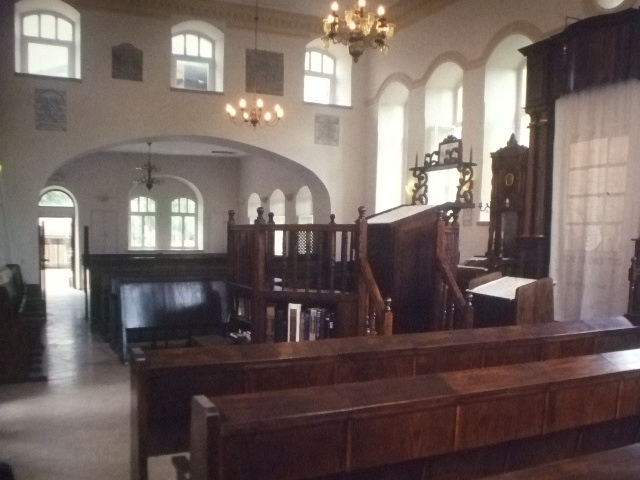
Thursday, November 10, 2016

קשה עלי פרידתכם — It’s hard to be away from you.

So sorry for our delay in writing.  Sukkot always tends to take over life in a big way and things were no different here.  We had to hit the ground running right after Simchat Torah.  Hannah started Tel Aviv University.  School for Zoe kicked in full swing, including having to take her first tests.  Seth was the same (without the tests!)  But I had my week of crazy deadlines which was accompanied by a nasty cold/virus that I got from Hannah.  Anyway, this is a long way of making excuses for not finishing the blog earlier.

Ok, back to Sukkot.

So on the first days of hol hamoed, while Zoe went up north with her Bnei Akiva branch, Seth and I went to Tel Aviv and completely indulged ourselves for around 30 hours.  We stayed at the Royal Beach Hotel, which is a fairly new Isrotel property that is so nice it even smelled great.  We treated it as our 20th and 25th wedding anniversary trip combined.  That sounds a little sad when I read it,  but there you go.

So the reason that Zoe was on a trip and we decided to take a trip is that the whole country uses Sukkot as the major vacation week for the year.  So when in Rome…..  

We shared a ride up with a friend of Allison’s whom we met the previous day at a fun and delicious meal in the Pollock’s sukkah.  It was nice to have door to door service. We dropped off our luggage and explored the city which felt huge and tall compared to Jerusalem.   The skyline is completely dominated by cranes because this city is under so much construction.  I would have loved to do a Bauhaus tour of Tel Aviv but Seth would have none of it.  He is a great husband but there are limits.  Bauhaus tours of TA are so my thing but not his.  We got to see plenty of Bauhaus on our walk anyway because it is everywhere.  When you take a bunch of displaced German Jews in the 1930’s and drop them onto a blank canvas of land and say build a city, what do you expect to happen?  Lots of great architecture and also lots of 21st century graffiti.

IMG_20161018_142406182.jpg
We made our way to the Sarona Market which is creative urban development and had lunch.
Passed an outdoor Science Fiction Festival which was crowded with young people dressed in crazy costumes- sort of a cross of steampunk, anime, and fantasy.  Strange.

Back at the hotel, we hung out at the pool for a bit (check out that view!)
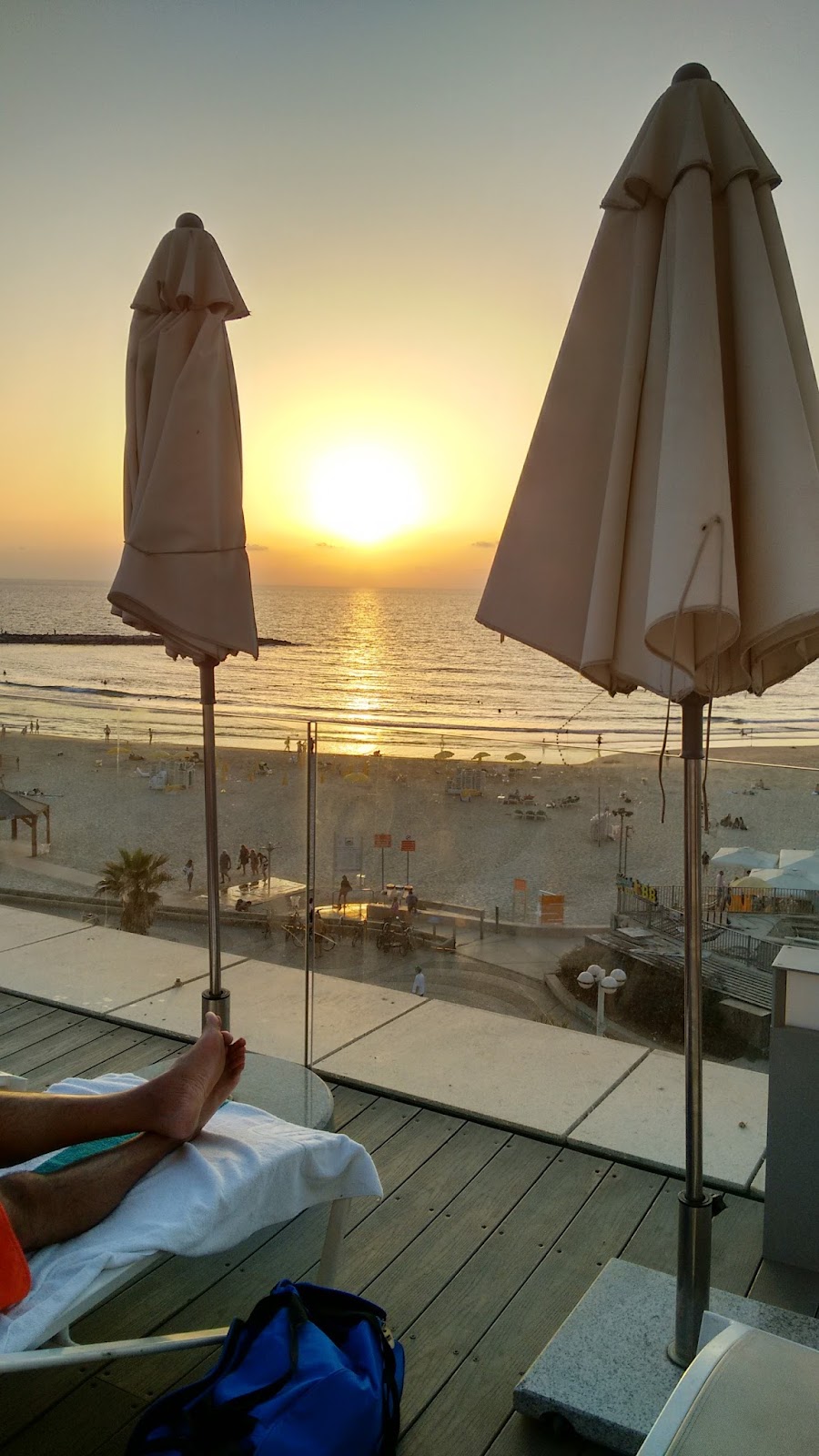
IMG_20161018_174756143_HDR.jpg
This was a treat.  The pool was on the 4th floor of the hotel so we got this amazing view of the beach and the weather was spectacular.  Actually perfect.

Then we made it to dinner. Meatos Fish Market.  We went to their original (meat) restaurant the last time we were in Tel Aviv (something like 5 years ago?)  We liked that, but we really liked this.   The food was great.  (Whole fish for me again, of course.) It was pretty empty when we got there, but there was a nice crowd in the sukkah by the time we left.  Sat next to a French couple with their 2 year old daughter and got to see French table etiquette in action.  Not a peep out of the child for the whole meal.  When there was a slight kvetch, the mother explained to the two year old that food would be coming in its time and that she would be having dinner when it was served, etc., etc.  This is how French people are made.  
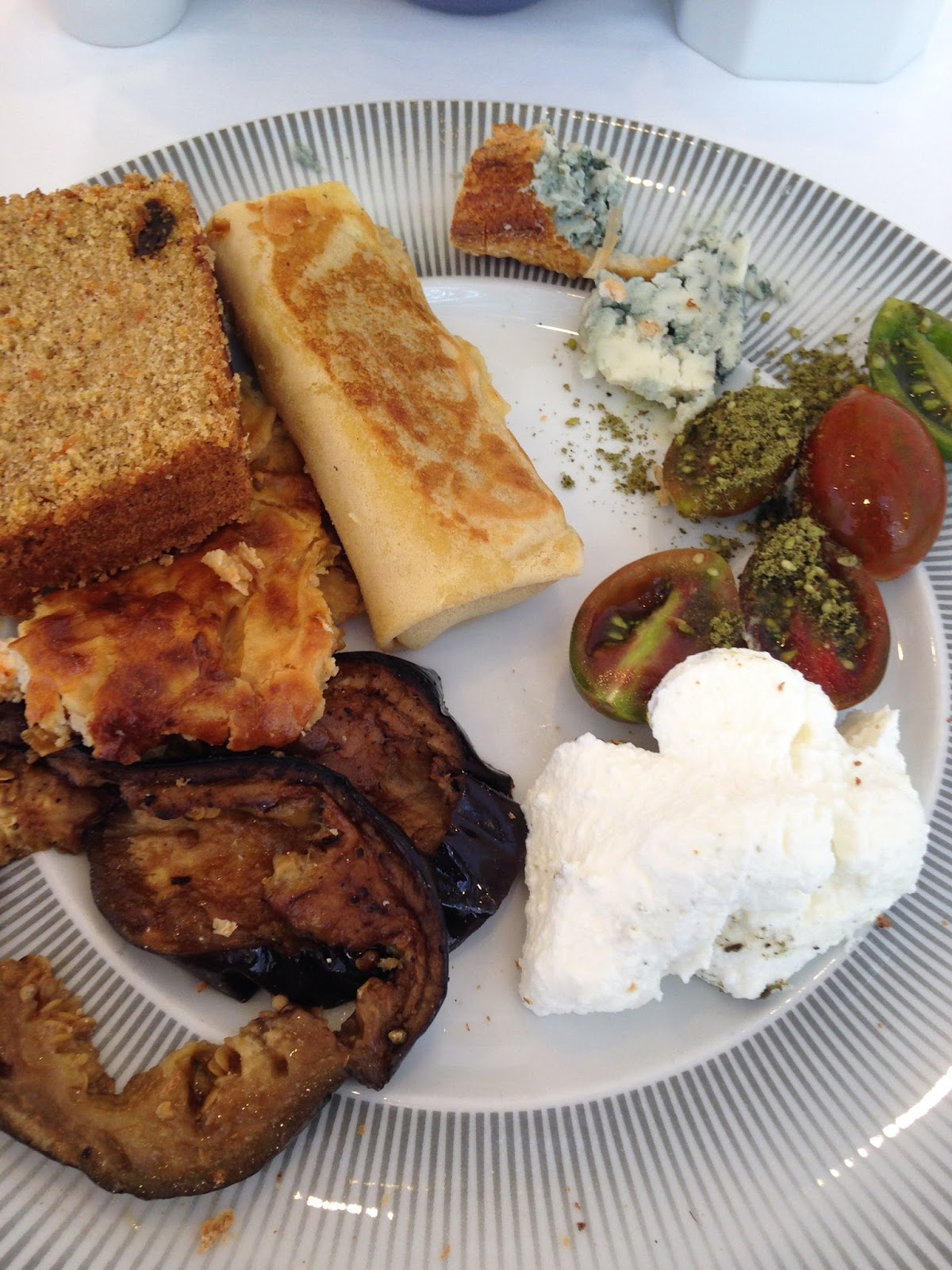
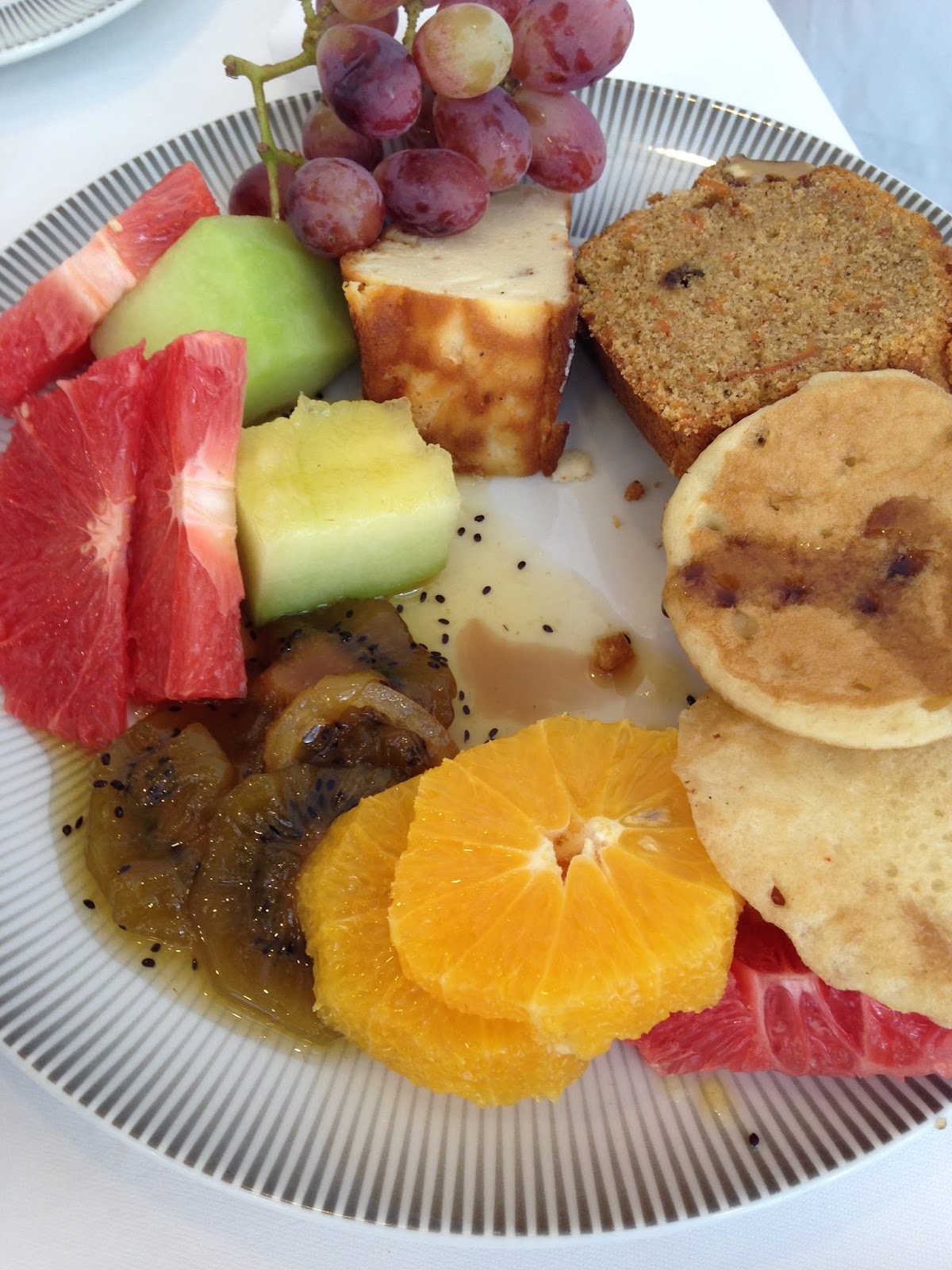
Tel Aviv is an amazing city so I hope it doesn’t sound too dismissive to say that the highlight for me and Seth might have been the hotel breakfast!
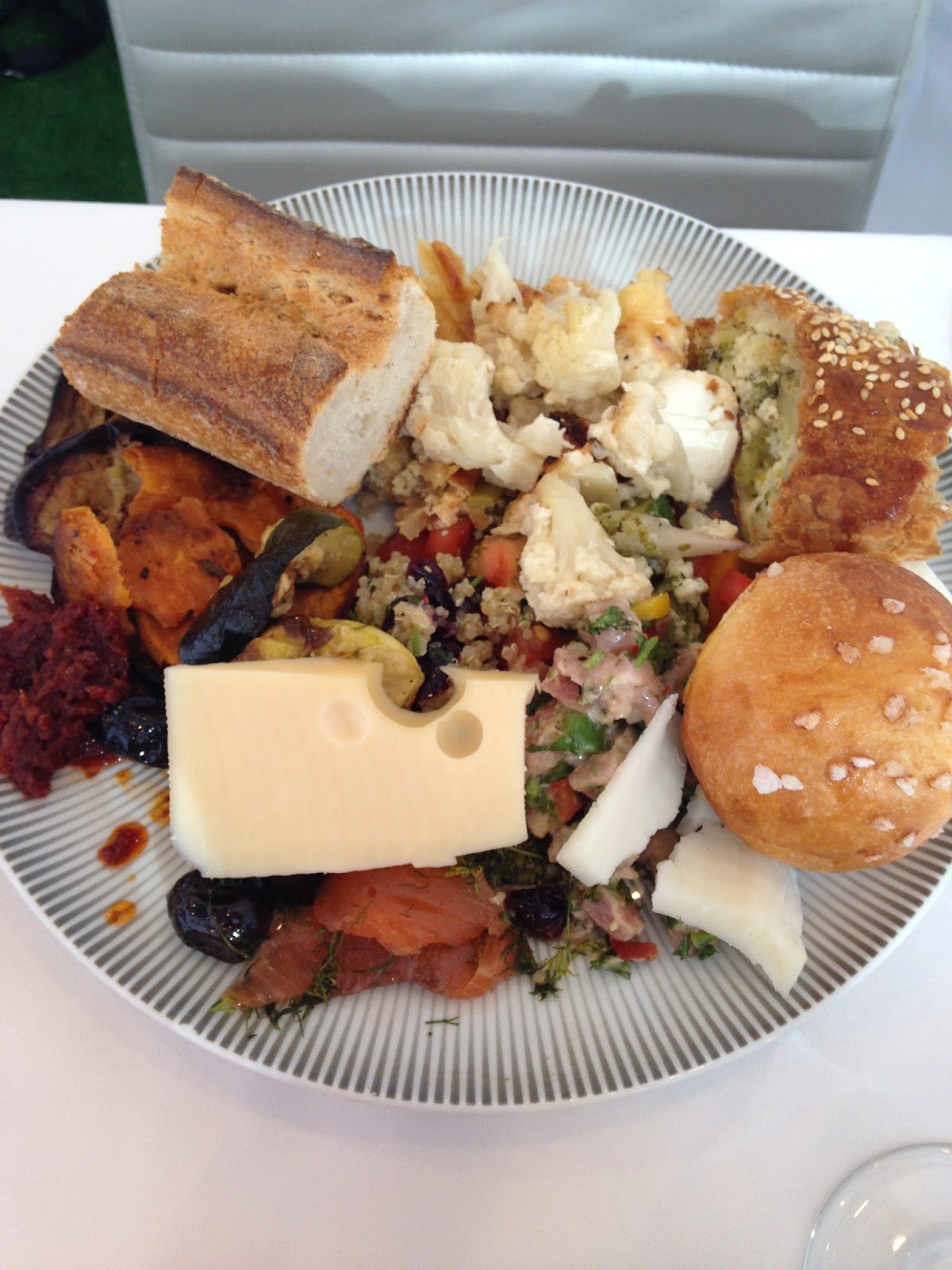
break 1.jpegbreak 2.jpegbreak 3.jpeg
Just so you know, I am really good at breakfast buffets.  You can ask the rest of my family.  They always are a little jealous of my plating skills.  But no need to boast.  

We had to check out by noon, so we dropped our stuff at the concierge and headed off to the Tel Aviv Museum of Art, which has a breathtaking collection of modern art (including one of the greatest Klimt's in the world) and is well worth the time if you’ve never been there.  There were two special exhibits including one by David Tartakover, a contemporary Israeli artist who is very political and very powerful.  Some tough images but really thought provoking and he is really talented.

We were still full from breakfast, so skipped lunch and spent our last couple of hours on the beach watching the ting tong players and surfers
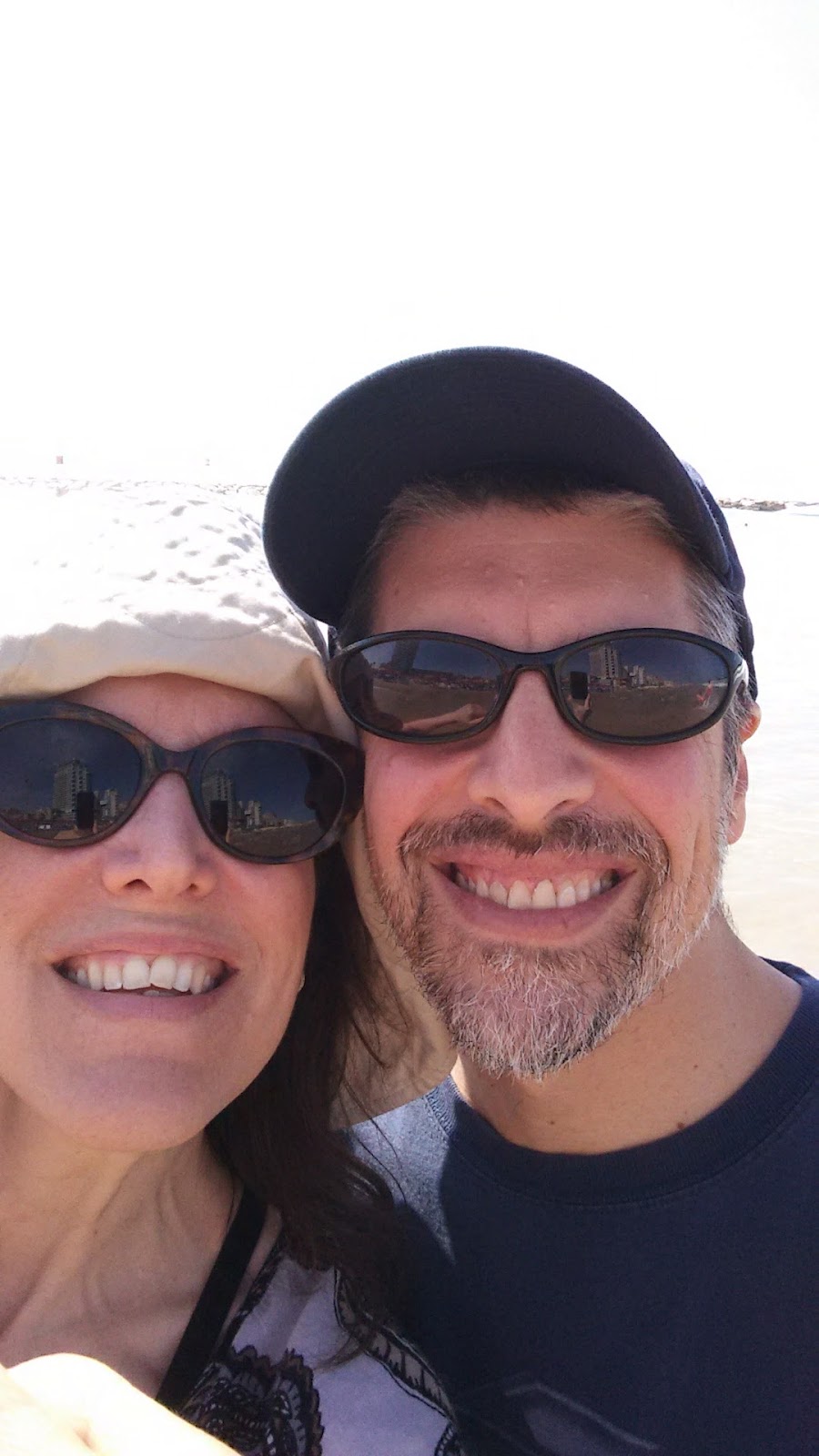
IMG_20161019_133627135.jpg

and back at the hotel pool where we experienced pure happiness on a covered pool bed that was very hard to leave (I was reading, The Goldfinch and Seth, The Corrections.)

We caught the train back to Jerusalem, which was a first for both of us.  So glad we did.  It is a slice of Israeli life both on the train and outside the window.  We got to see the Kresch’s apartment building as we passed through Beit Shemesh.  And then the views became something really spectacular -- winding through hills as we got closer to Jerusalem. IMG-20161019-WA0002.jpgIMG-20161019-WA0003.jpg
But duty calls and while I took pictures and listened to music, Seth got tapped to make a minyan for mincha.  So here we are during sukkot, on the train between Beit Shemesh and Jerusalem and you get ten men together representing a good slice of the Orthodox world.  A couple srugim kippot a la Seth, two massive streimels of the most elaborate fur, two Bratslavers with two white beanie kippot, and don’t know who else, except no known Sephardim, because the Sephardic guy said no if they were davening Ashkenaz.  Really? And just so you know, it is not easy to daven mincha when a train is winding through the mountains outside of Jerusalem.

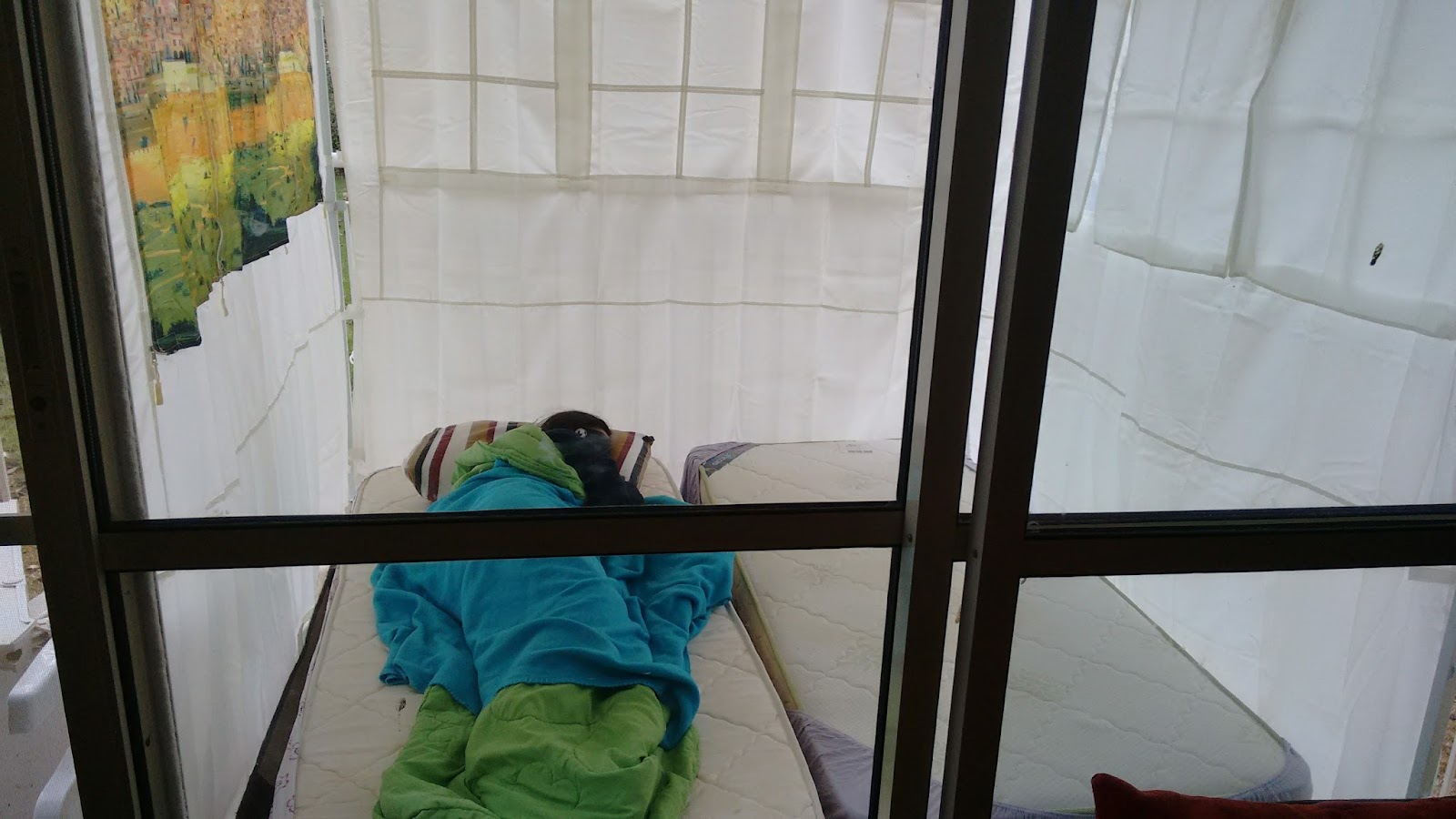
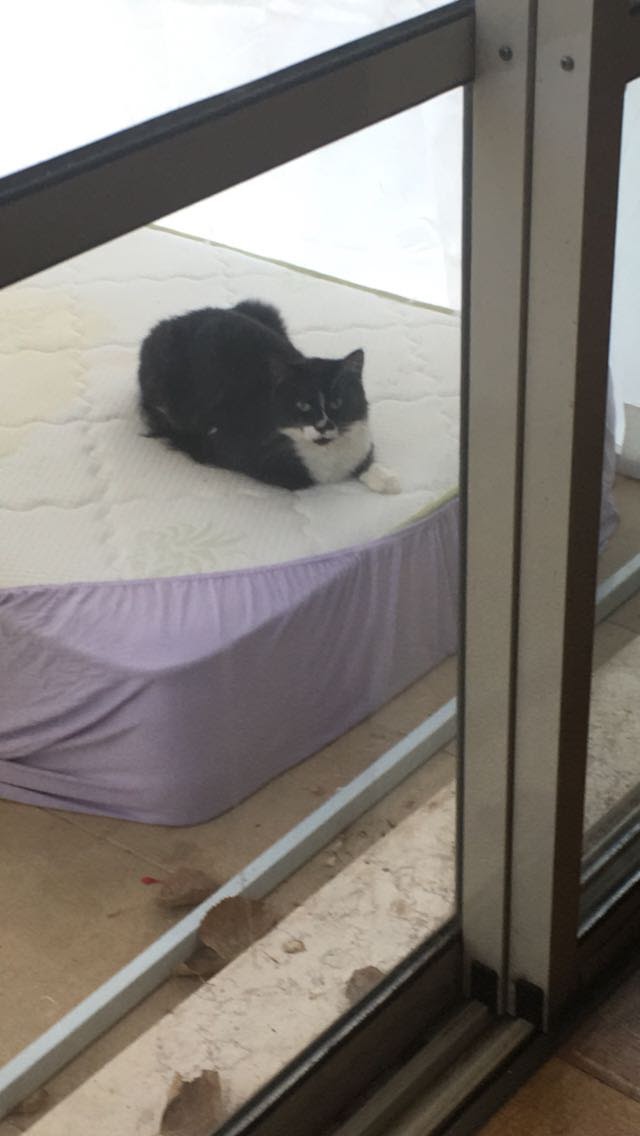
Zoe and Seth  got one night of sleeping in the Sukkah in before the Chag ended.  IMG_20161023_074044847.jpg Also, check out one of the many cats who live in the park that is our backyard.  The cats loved Sukkot.  Decided to move in.
IMG-20161023-WA0000.jpg

The rest of the week was spent just hanging out, a lot of it with friends.  The Goldmeiers (all of them + Nati!) were in town and it was a treat to spend time visiting them on Shabbat.  

We were so lucky to meet one of Hannah’s apartment roommates, Eliana. She's great. And a hugger!IMG-20161025-WA0000.jpgWe had been waiting to meet her for a long time so we were excited to have her stay with us for the last day of Sukkot, as well as Anna Warshay who was in town and got to share Zoe’s bunk bed.  One of my favorite meals so far was Simchat Torah lunch with us, Anna, Eliana, Madi and Abe and Yoni Nadel.  Talk about feeling like home but a little better.  It was a great day.  I will tell you about it.

So guess what Shemini Atzeret is?  I don’t know, I never have, and now that I have spent Sukkot here, I am even more confused.  All the Rabbis ended up giving their talks on how we need to acknowledge Shemini Atzeret, etc. but I think the lady doth protest too much, if you know what I mean.

But how great is one day of Chag?  There was so much time in between Yomim Tovim to spend appreciating the weather and the city; there were festivals everywhere and there was so much going on.  Israelis always seem up for a party.  I did not spend every minute shopping, cooking and eating.

This is how we spent Shmini Atzeret/Simhas Torah last day:

From Seth: I went with Benjamin and Asaf Pollock to the Bratslaver Bet Midrash for hakafot.  It was memorable (I particularly loved the boys’ rebbe who lead their choir jumping up and down on a not-so-stable-looking table and throwing candy to the boy’s non-stop the entire time.  I’ve only ever done something like that once before (25 years ago on a trip into Brooklyn) and had a similar feeling of being out of place.  The dancing was definitely spirited, but I was happy to leave, feeling like I didn’t belong there and almost as if I was at a performance instead of celebrating myself.

The women went elsewhere.  Zoe, Hannah, Eliana, Anna, the three Pollock women, and I  started off at Ramban and then walked up to Yakar.
Ramban was very nice.  After a slow start the women did their own hakafot and it ended up being a good turn out and good dancing (including with Talya Kresch).  We left after a while to check out the “It” place for Simchat Torah which seems to be Yakar.  As we approached up Kovshei Katamon, we saw the crowds outside the shul taking over the streets.  The men dance outside and they turn the inside over to the women.  Crazy, spirited dancing and singing with sooooo many young people.  Hannah walked in and said I think I know about 40 people here.  All people she has met in her few years in Jerusalem. When they reached the last Hakafa, they brought in the mechitza and the men came in so that the room was packed.  The men danced and sang on one side with the Torah and the women on the other.  And for the final Hakafa we sang Sholomo Carlbach’s Yerushalayim at the top of our voices and I knew that it was a not so thinly veiled reference and counterpoint to the Unesco vote on the Temple Mount which had happened right before the chag started.   We spilled back into the street which was showing no signs of letting up and ran into Hannah’s second roommate, Jess, who happened to be there.  It was the kind of place where that would happen.  Jess is South African and quite charming and beautiful.  

We walked home through very crowded streets and had a late but very fun meal that ended with Ben and Jerry’s.

Then we got up to do it all again.  Went to our regular shul, Nitzanim, where we ran into Yehuda Rothner, the recently retired director of Camp Stone and his wife, Adina. Had a great conversation with them about our year so far.  I think most people would agree that Yehuda’s goal in life is to get as many Jews to live in Israel as possible. He is a legend and deserves his own blog.  Maybe another day.  
My one regret from the day is that I went home early to check on lunch because the davening was very late.  I ended up missing what our lunch crowd described as the “most beautiful Tefillat HaGeshem they had ever heard.”  Now if you know our lunch crowd (see above) you know they have been around so that was saying a lot.  Tefillat HaGashem is the prayer for rain which is always done on this day.  We had not experienced a drop of rain since we arrived in Israel and we were so convinced that Sukkot would be rain-free we put our wood dining room table outside in our Sukkah. And it was.  But the beauty of that Tefillat Hageshem proved even more powerful the next day when the first rain in months came, right on cue.  That’s an “only in Israel” experience if there ever was one.

That night after the chag ended, Jerusalem has developed the tradition of keeping the party going with what they call “Hakafot Shniyot.”  It is just more dancing and music and fun.  Zoe and I went to a gathering off of Emek Refaim with Soul Farm and Shlomo Katz.  Very fun, especially when we ran into Hannah Korelitz and Eliana and much dancing ensued.  Zoe and I left a little early and on our walk home we got another huge holiday treat of bumping into Avi Greenbaum who was talking to Merav Edrei on the street.  Crazy Akiva reunion.  And then we went home and it was all over.

Happy, but missing you all, we’ll do our best to stay dry and warm as winter approaches.

What happens in Israel...


Sunday, October 23, 2016

ime of Our Joy - זמן שמחתנו

Whoa!  Sukkot is big.  We really need a couple of blog posts to relate everything.  Apologies in advance if even this first one is a bit long and/or rambling.


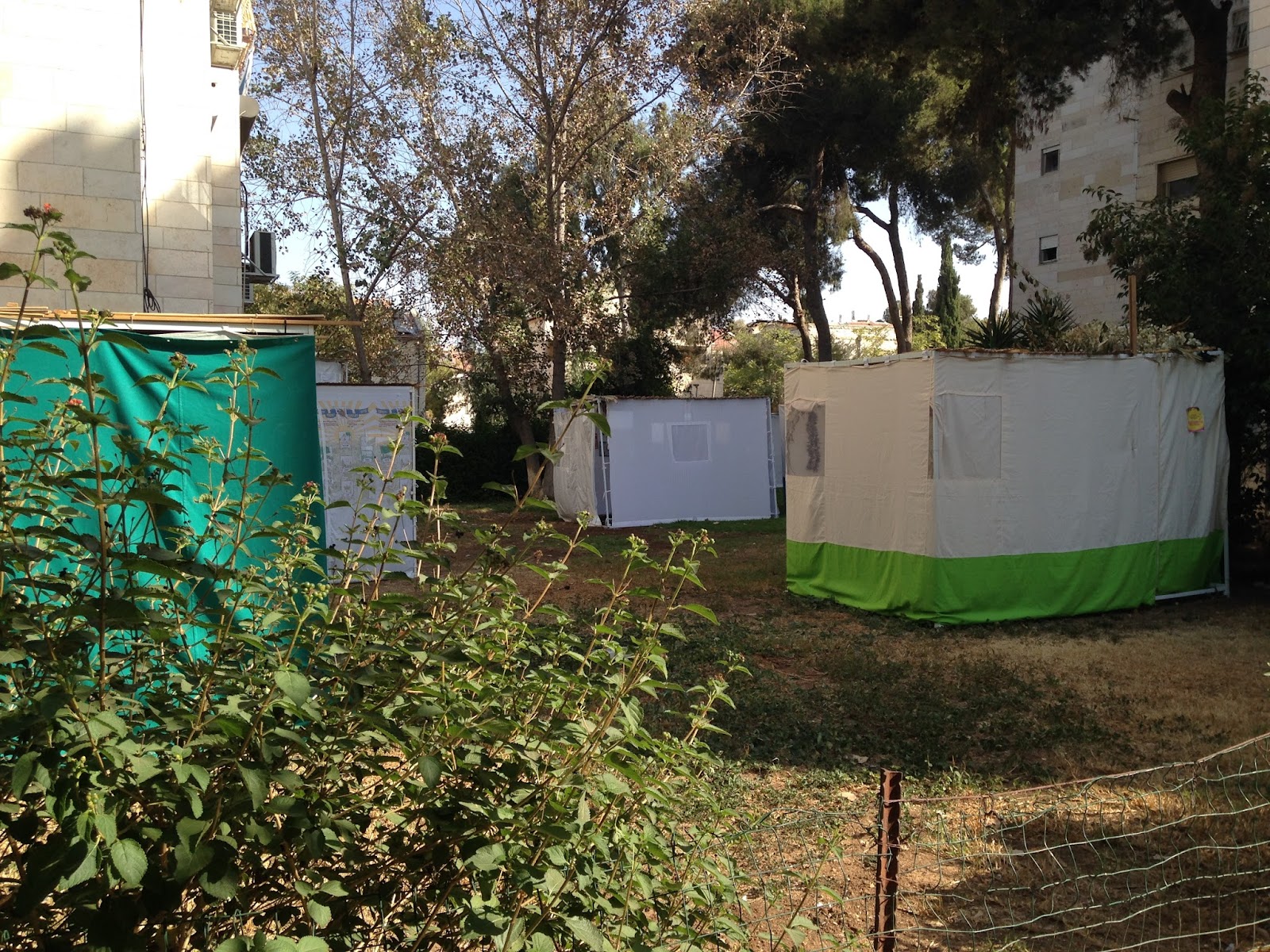
We wrote last time about how everyone and everything stops on Yom Kippur; even if they’re not observant the rest of the year -- maybe didn’t even go to shul for Rosh HaShannah -- no one is out as if it’s a regular day.  Sukkot has a similar, albeit less engaged feel.  People who might not typically live their daily lives by Jewish rhythms get caught up in Sukkot here.   (Here’s a shot of the half dozen sukkot in our backyard).
File_000.jpeg


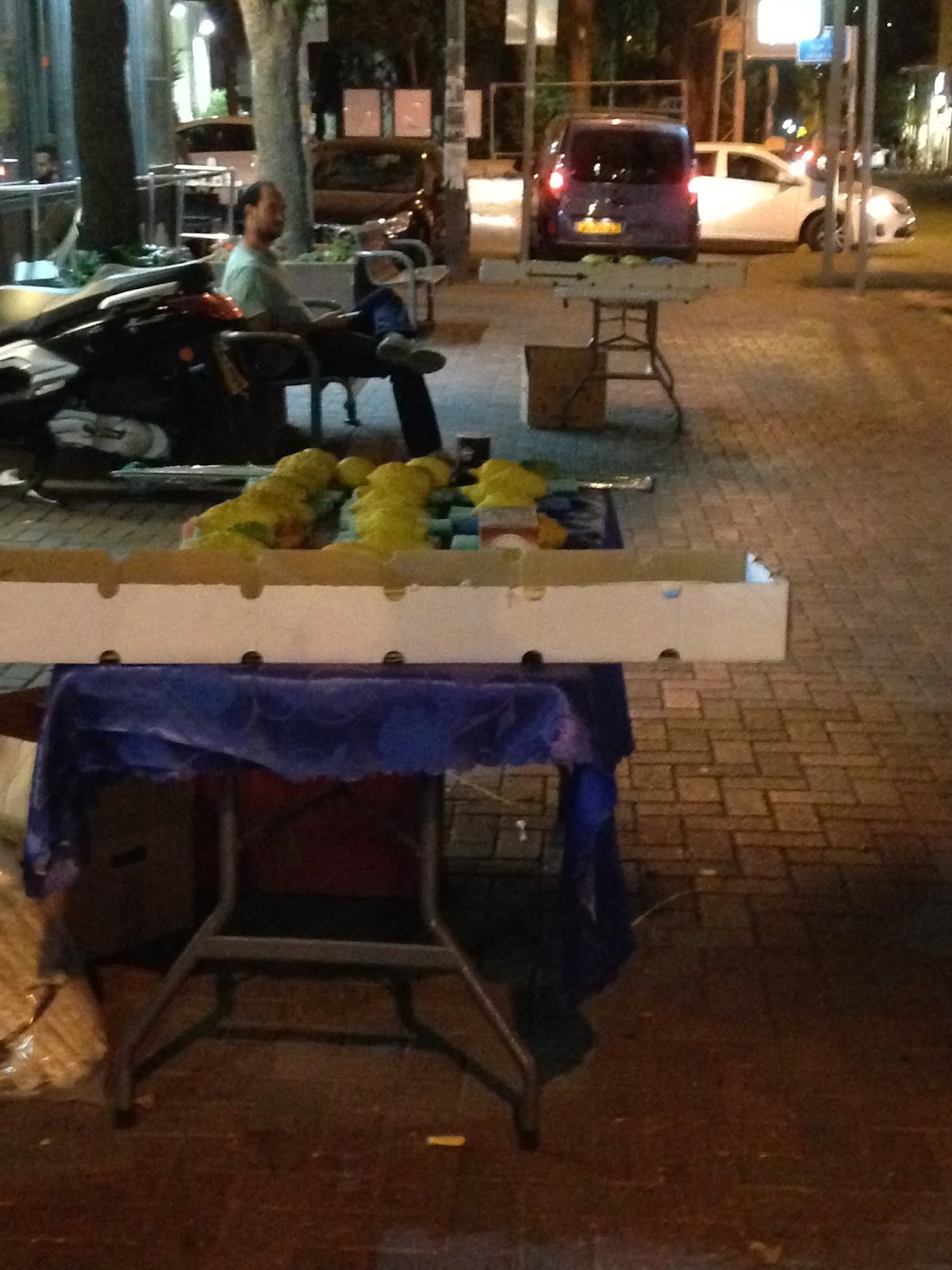
You can get Sukkot all over the place.  There were about five places within a five minute walk from our house.  Think (l'havdil) Xmas trees at home: stands pop-up wherever there is an open lot.File_000.jpeg
We bought our’s near the gas station/24-hour market near our house and carried it home.IMG_0911.JPG

It was wonderful.  It’s small (only 6x6) and individual tarps (instead of having to wrap one piece all the way around, like at home), both of which made setting it up so simple that it only took about ten minutes beginning to end.  File_000.jpeg


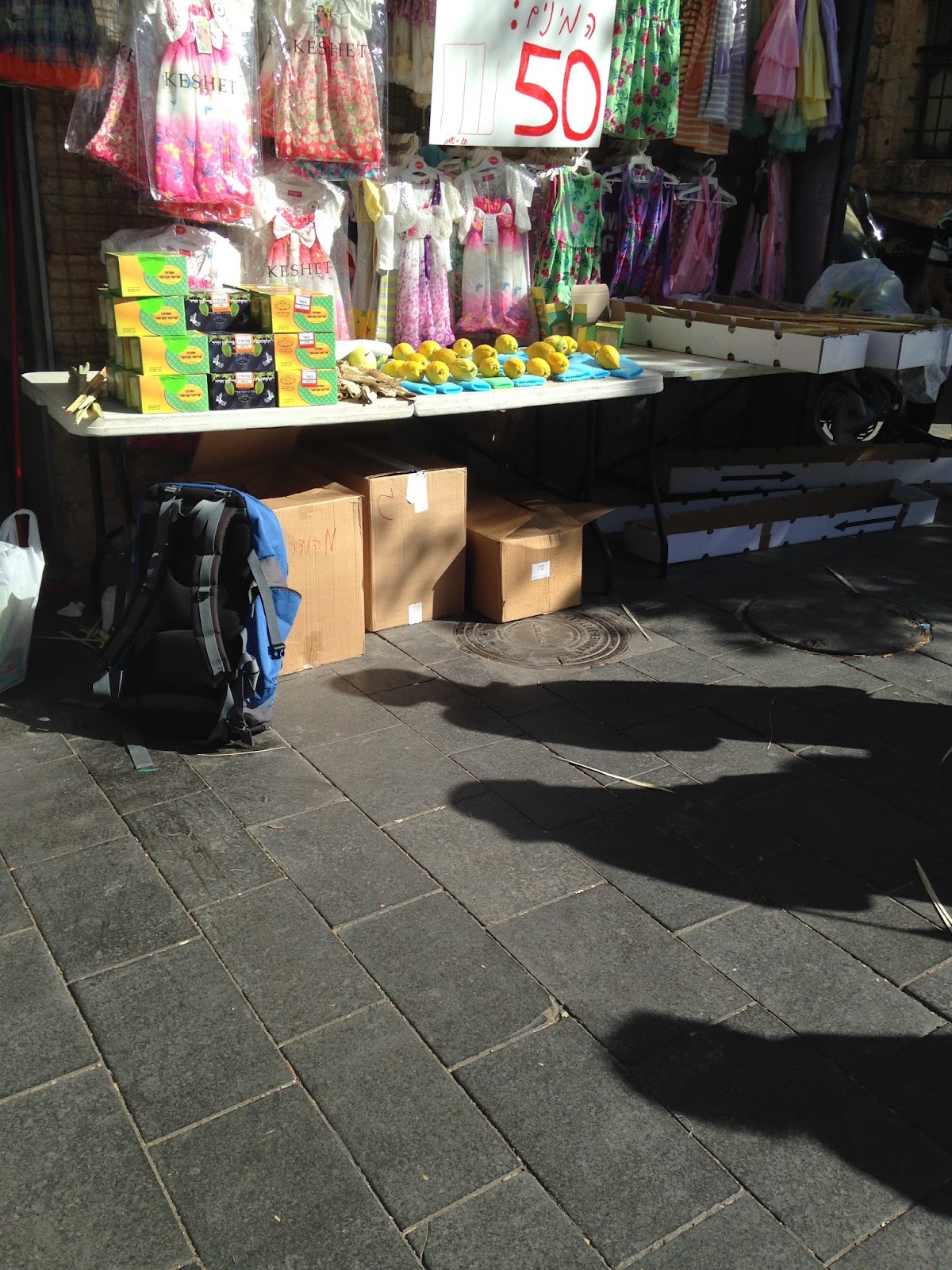
You can get lulav and etrog all over the place, too. Copy of IMG_0962.JPG
IMG_0964.JPGEven where you get clothes for your little girls
IMG_0974.JPG

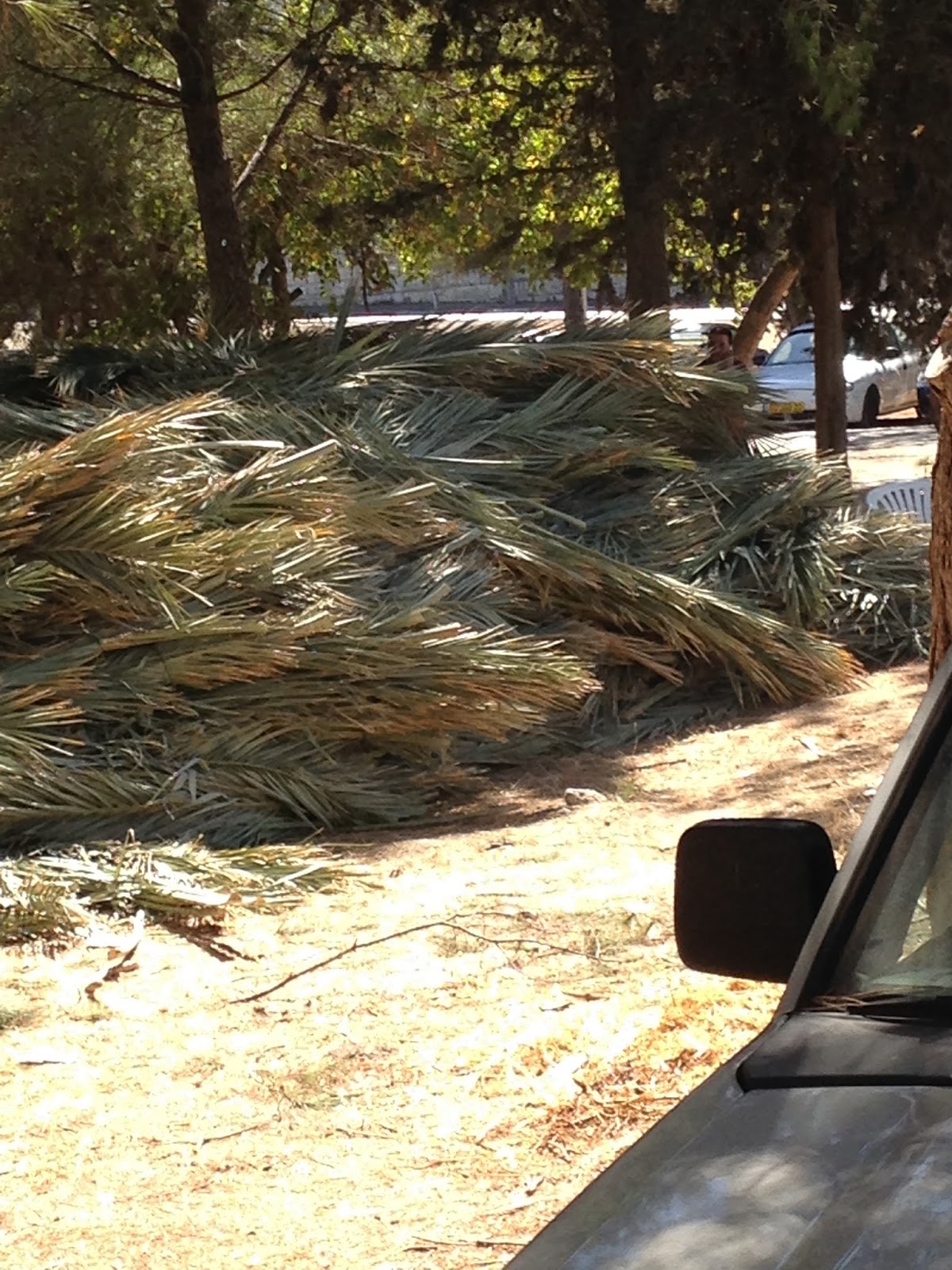
And not just the sukkah kits or arba minim, but everything else you could want is readily available.  Like palm frondsIMG_0935.JPGIMG_0936.JPG,

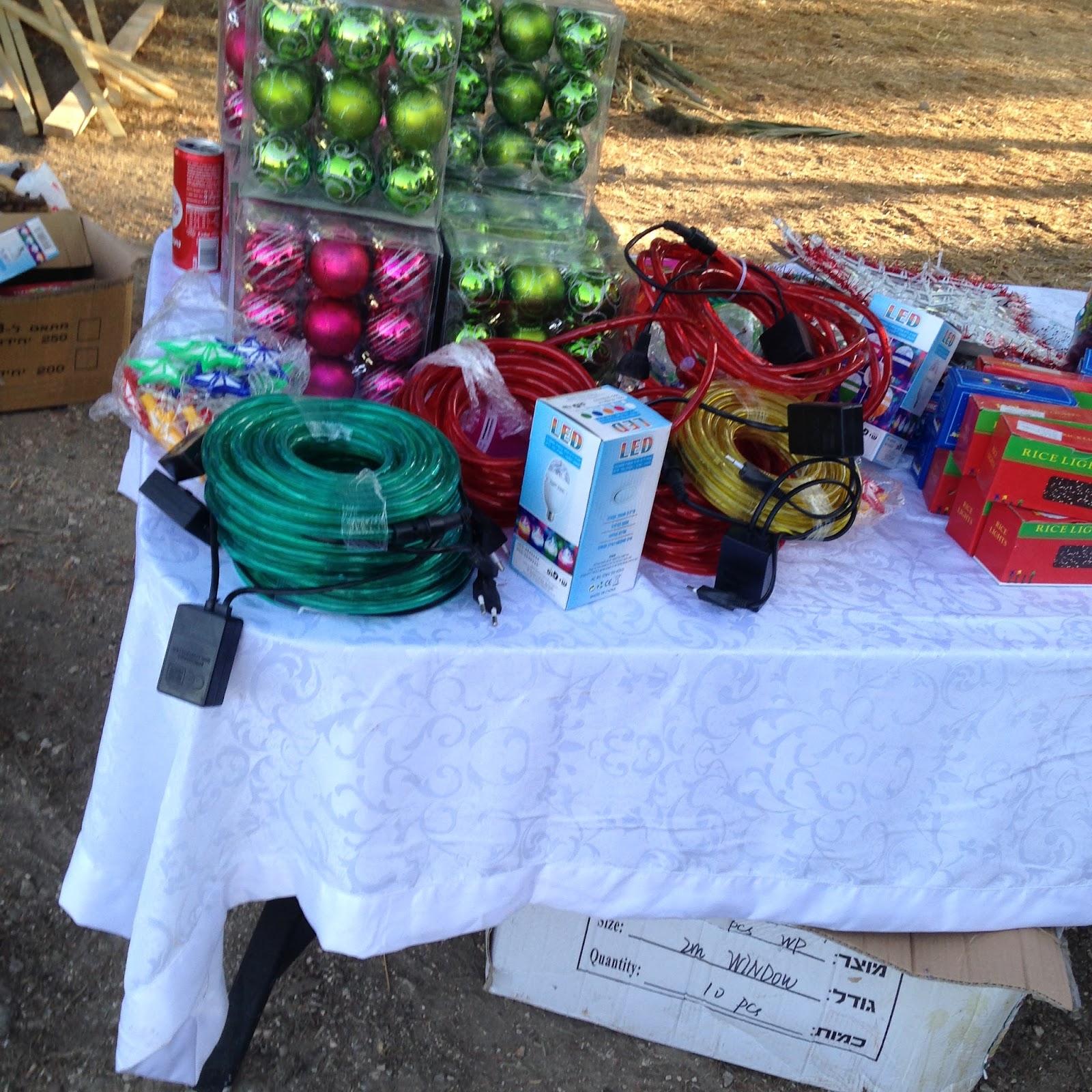
or sukkah lights

IMG_0983.JPGIMG_0984.JPG
They were even selling sukkot, arba minim, and posters/sukkah decorations at our grocery store!


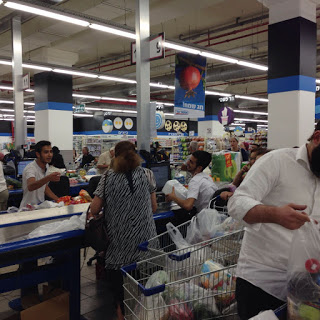
I do not think I can describe the grocery stores here to you.  I am sending you a picture of our main grocery store, Osher Ad, right before Rosh Hashana but you can’t really see how the lines are a dozen deep and people sometimes have two carts filled to the top.  
And sukkot is worse.  We were told by Hannah’s friends the Engelharts that we need to buy chicken before the holiday because they do not schecht chickens over the chag and the country runs out of chickens.  We didn’t actually see this, but the stores are madness.  There is a lot of yelling in the lines at Osher Ad, but usually the person deserves it.  There are unspoken rules of behavior when it takes you 45 minutes to an hour to check out of a grocery store and Israelis are not shy about enforcing unspoken rules. People just to talk to each other here as if they are part of your family, for better or worse.  Yes, preparing for Sukkot was madness!  


And that’s even with our being invited out for both meals on the first day of Sukkot. Dinner was at family from Nitzanim, Mary and Yonah Fuld (former head of SAR) with some of their friends.  Great people, we had a wonderful time.  Another great group for lunch, at the Pollocks with some old friends of theirs.

Everyone went their separate ways during Hol HaMoed.  Hannah was a little under the weather (still run-down from Thailand?) and went back to Givat Shmuel to sleep for a couple of days straight.  Zoe went up north for an overnight with her Bnai Akiva branch, and Sheryl and Seth went to Tel Aviv for a belated (20th. And 25th) anniversary get away.  We'll pick up that story next time.

Enjoy the last day(s).

What happens in Israel...

Sunday, October 16, 2016

שערי תשובה לעולם פתוחים/Knockin' on Heaven's Door

Since I have changed jobs, the notion of the holiday season has changed for me.  When I owned my store, Thanksgiving was just about the least relaxing holiday imaginable.  I always promised myself that when I was no longer in retail, I would spend Black Friday as far away from a store as possible.  And I do.  But now in college guidance, the Chagim sometimes creep up and I cannot devote the time to them that I would like.  I used to like to devote time in Elul to studying and preparing for the Yomim Noraim.  Pardes, where Seth is studying, had a fabulous Elul study schedule that I was very tempted by, but from which I refrained.  I just knew it could not happen this year. (Once my high work season is done I will get to do some of that learning that I have wanted to.  The next Pardes season starts on October 31 and I have signed up for two classes.  That should change everything.  I will let you know.)

Farber Hebrew Day School has generously allowed me to work long distance this year.  I’II admit it has been a challenge sometimes with the time difference: for example, my College Informational Night for seniors and their parents in September that took place by Zoom at 7:00 PM EST in Farber’s Media Center.  For those of you who are paying attention that was 2:00 AM Jerusalem time.  Not my best time of day.  But it worked.  Plus, I have been Skyping, calling and emailing with parents, students, administrators, college reps, etc.  And, yes, it works, but I really miss being around the kids.


On top of this, I have been working for a company in Tel Aviv that advises Israeli students applying to American universities.  It is mostly a test prep company but over the past couple of years has become more full service. Right now I have four students whose undergraduate applications I am overseeing, but I have also conducted some staff and student workshops.  It is great meeting real Israelis and getting out of my Baka bubble.  I have had to go to Tel Aviv three times and I have learned to enjoy that bus trip. I can tell you that 22 year old Israelis who are post-army, have done some traveling, and are working, are nothing like 17 year old Jewish suburban teenagers applying to college.  And just so you know, Israelis are crazy smart at math.

Now back to the Chagim.  I really just wanted to be sitting in a shiur somewhere thinking about Repentance, but I have most of my Farber students apply to schools by November 1, the early deadline.  I need to write letters of recommendation for all of them, edit their essays, etc.  Plus I am editing Israeli essays.  So I went into the holidays with no prep.  
When Shabbat Shuva (the Shabbat between Rosh Hashana and Yom Kippur) rolled around, I decided that I needed to get to work.  Traditionally this Shabbat and Shabbat HaGadol (the one before Passover) are big in the world of rabbinic talks.  Rabbis usually give their “big” talks then and it can be pretty exciting in a place like Jerusalem.  So last Shabbat I double dipped: I went to an afternoon talk at Congregation Ramban with Rabbi Benny Lau and a post-Shabbat talk at the Great Synagogue by Rabbi Shlomo Riskin.  We saw a poster for Rabbi Riskin’s talk on the street when we walked to our Shabbat dinner.  It was posted like a concert for someone famous.

Rabbi Lau’s talk was in Hebrew and I knew that I would not get most of what he was saying.  And I didn’t, but he is great to listen to.  He has a way of speaking that is very compelling and I did understand the gist of what he was saying.  His subject was the red string that was tied to the scapegoat on Yom Kippur in the days of the Temple.  Pretty obscure but, of course, he tied it to bigger things.  Rabbi Riskin’s talk was ostensibly on Yonah, repentance and the LGBT community.  I was excited to see him because he is so famous and it was an event, but I did not love the talk.  There was definitely great energy in these rooms and I was so glad to be there.  People are always learning here and that is also inspiring.


So Yom Kippur was approaching and I was really looking forward to just sitting in shul for 24 hours.  Rosh Hashana was really wonderful here and we were starting to feel at home at Nitzanim, our chosen shul.  (And I guess we shouldn't have complained last week about having to buy tickets. It could have been a lot worse). Which brings us to another really nice thing that happened last Shabbat; we were invited to a new members’ Kiddush for Nitzanim at the apartment of the shul’s president. People have been very friendly and welcoming and we enjoyed meeting this crowd of mostly Anglo newbies.  We have noticed that there are quite a few mixed marriages here of Brit/American couples.  Also, in case you were wondering, Australians just seem to be more fun than everyone else.  And everyone has a story.  Seth and I are getting tired of hearing us tell ours over and over again.  As Zoe said when we left the Kiddush, “I think you have told the same stories now about a thousand times.” It’s true.  But I love hearing everyone’s stories of why and how they got here.  Some of these people came like Hannah when they were 18; some are coming now with children of varying ages; some bring their 90 year old parents along with them.  There is a woman I am friendly with at the gym (who is also a longtime friend of Allison Pollock’s) and when she heard our story, she called us “fakers,” which she said nicely by the way.  We did not mind.  We are fakers.  The commitment to live here and raise your children knowing they will go in the army is a different ballgame.  And kol hakavod to them all.

Back to Yom Kippur.  Forget Passover.  Forget Sukkot.  Forget summer break.  If you want to choose a time to visit Israel, Yom Kippur is the day. The whole country shuts down.  And I mean shuts down.  No public transportation. Everything is closed.  The traffic lights are turned off.  We went to Kol Nidre services (which were beautiful) and when we emerged and stood at the corner of Pierre Koenig and Asher, we watched as a sea of white filled the streets. Everyone was dressed in white and walking in the middle of the street because there were no cars.  And Kol Nidre night seems to be the biggest playdate of the year for the kids.  They bring their bikes, scooters, kiddie vehicles and even a shopping cart and ride through the streets at full speed with no worry of traffic.  The city was so quiet except for the sound of voices. There was an echo in the streets.  It was magic.  So you might want to put it on your calendar for next year.
______________________________________________________

"It’s unbelievable, it’s strange but true"
(Bob Dylan, “Unbelievable”.  1990)


Sheryl was clearly excited as she ran, the girls in tow, to the mirpeset (porch) where I was putting up our Sukkah.  “Guess who won the nobel prize in literature,” she practically shrieked?!  (If I had the talent to have been so honored, I would better be able to describe how overwrought she was.  Alas.)


I immediately guessed Philip Roth, but in retrospect she would not have been that excited for Roth.  Bob Dylan never entered my mind, though here Sheryl’s excitement makes sense given my unparalleled musical passion for him. Who knew his name has actually been in contention for a while?  Not me, obviously, but evidently others.  


In any event, what’s this doing in our Israel blog?  I could stretch it -- mention his famous visit to the Kotel in the early 80s, and "Neighborhood Bully"


right around the same time -- but it would feel inauthentic.  


Likewise, there are lots of discussions of Jewish/Biblical references in Dylan lyrics.  Without for a second denying there is something very, very Jewish about Dylan, at the end of the day his is a quintessentially American story.  Still, this was just too big to go unmentioned.

What Happens in Israel...

Friday, October 7, 2016

קול שופר

 .We had a wonderful Rosh HaShanah

First, the meals!  First night we got to eat at the Kashuks again. Tasty food of course, and good company.  The highlight of the evening though, was meeting Aryeh Leib “Eugene” Lebovitz.  I couldn’t possibly do this man justice with my words, but when you have a few minutes to be inspired, I recommend you click here and here to find out about his story.

The next day we had a reunion block party: lunch at our apartment with the Pollocks (who used to live about five houses down from us in HW) and Aviva Cohen/Brad Bernstein and Yonah (formerly across the street from us).  As “outsiders,” we were also fortunate to have Abe and Madi (Warshay) Truitt.  We double (quadruple) dipped, and also used the meal to celebrate some recent simhas: anniversaries for Benjamin & Allison and for Brad & Aviva, birthdays for Asaf and Brad.  By the time Sheryl’s delicious and plentiful meal was over we had a very short turnover before it was time for “dinner,” at which the four of us didn’t have much more than kiddush and a little challah with Kresch honey.

Day two we walked about 25 minutes to the Pat neighborhood (locale of Nishmat, Hannah’s home during her seminary year) to have lunch with former Akiva teachers Aviad and Leah Sanders and their four kids.  It was great catching up with them.

I seem to remember there was something else to Rosh HaShanah other than the meals?  Oh, right: shul.  So, to begin with, it didn’t occur to us that we would be paying for synagogue membership this year, but we did end up needing to buy tickets for Yomim Noraim.  It turns out that there are some Israelis who don’t actually go to shul all the time but show up for RH/YK, and so places get filled up.  Who knew?  

We ended up deciding on Nitzanim, which has been our primary synagogue so far.  By the time we got around to signing up, though, all that was left was room in the overflow service downstairs.  This might actually have ended up being the better choice; the chairs (plastic) aren’t as comfortable as upstairs, but it was less crowded and less talking than normal.  (And the price was half of what it would have been upstairs!)  The ‘backup’ prayer leaders/Torah readers/shofar blowers were all good, some quit so.  Overall a pretty intense (in a good way) and inspiring experience.

One of the unexpected highlights for me may in fact have been enhanced precisely from being in overflow.  The room downstairs has a sliding door to the outside, which was left open to allow the breeze (and kids) to easily come into the room.  The first afternoon, as we were finishing Torah reading, I heard the sound of the shofar from a nearby shul, or maybe just from the minyan upstairs.  (I had almost the exact experience on the second day.  I stepped out to do some reading during the rabbi’s sermon -- my Hebrew’s not as good as any of the women in my family, and I didn’t think I’d be able to fully follow it.  Standing there, I could hear another minyan’s shofar, the rabbi’s Dvar Torah, and some Sephardi piyut from the minyan in the bet midrash.)

The experience reminded me of a famous mishnah:

וכן מי שהיה עובר אחורי בית הכנסת. או שהיה ביתו סמוך לבית הכנסת ושמע קול שופר.... אם כיון לבו. יצא. ואם לאו לא יצא
And so he who was passing behind a synagogue, or whose house was adjacent to a synagogue, and heard the sound of a shofar ... if he concentrated his heart, he has fulfilled [his obligation], but if not, he has not fulfilled [his obligation].

The simple upshot of this mishnah is that it’s not enough to just hear the shofar blowing; you have to actively listen to it, with the intention of fulfilling the mitzvah of hearing the shoar.  

As with many halachic discussions, the “legalistic” arguments are often helpful in thinking about more “spiritual” matters as well.  In our case, when you are in between, moving from one place to another, intentionality is all important.  
And this is where we all are right now, during the Ten Days Teshuvah: standing in between.  We can hear the voice of the shofar, the words of our tradition, even our own prayers.  All of it is for naught, though, if we don’t have the right intention.  The Rabbis famously say that Yom Kippur is like Purim.  (It is a yom k’purim - literally, a day like Purim).  Identities and fate are in flux, covered up, and we have to decide whether or not we want to remove the masks we wear, which hide our true selves from others and ourselves.  It’s not easy work any way you cut it, but it’s impossible without the right intention.  May we all be able to garner the focus we need to help us become the people we want to become in the upcoming year.


OK, that’s the last dvar Torah for a while, I promise!  Next week back to regularly scheduled programming!  In the meantime, גמר חתימה טובה


What happens in Israel...


Friday, September 30, 2016

ראשית צמיחת גאולתנו

Last Saturday night I went to slichot services (special prayers said leading up to Rosh HaShanah).  Slichot was preceded by a great talk by one of the teachers at Pardes, Zvi Hirschfield.  Everything that evening was great: the chazzan was wonderful, the weather made for a lovely walk to and from shul, and the location itself was inspiring: the lovely little synagogue in Yemin Moshe, with a view of the walls of the Old City.


There is so much that could be said about Rosh HaShana, but I find my thoughts turning right now to the death this week of Shimon Peres.  Sheryl, Zoe, and I tried to attend his funeral today, but couldn’t make it. (We got as far as the light rail, but the city had to shut down service to Har Herzl, we assume for security/crowd control reasons.)

While some people were troubled by Peres's positions on the peace process, many (myself included) find it hard not to at least recognize and appreciate the contributions of a man who devoted his entire professional life to the State of Israel, since before there even was a State of Israel.  Shimon Peres was center stage in Israeli history for over sixty years!


This kind of dedication reminds me of a Yehuda Amichai poem, which itself could serve as a useful meditation for the Yomim Noraim:

A Man in His Life

A man doesn't have time in his life
to have time for everything.
He doesn't have seasons enough to have
a season for every purpose. Ecclesiastes
Was wrong about that.

A man needs to love and to hate at the same moment,
to laugh and cry with the same eyes,
with the same hands to throw stones and to gather them,
to make love in war and war in love.
And to hate and forgive and remember and forget,
to arrange and confuse, to eat and to digest
what history
takes years and years to do.

A man doesn't have time.
When he loses he seeks, when he finds
he forgets, when he forgets he loves, when he loves
he begins to forget.

And his soul is seasoned, his soul
is very professional.
Only his body remains forever
an amateur. It tries and it misses,
gets muddled, doesn't learn a thing,
drunk and blind in its pleasures
and its pains.

He will die as figs die in autumn,
Shriveled and full of himself and sweet,
the leaves growing dry on the ground,
the bare branches pointing to the place
where there's time for everything.


As most of you are aware, one of the main themes of Rosh HaShanah is the shofar.  The Torah itself doesn’t even know the term Rosh HaShanah and calls the day “Yom Teruah,” the Day of sounding [the shofar]. There are numerous explanations of the shofar’s connection to Rosh HaShanah, most of them relating to our connection with God.


One related idea that should also resonate with us when we hear the shofar is the shofar blast as a herald of moshiah/messiah.  You may agree or disagree with how Peres went about it, but we all share his dream of Israel living in peace and harmony with its neighbors. Living and learning in Israel right now, I am inspired by the dreams of Shimon Peres, and the millions of other Israelis striving to strengthen the Jewish people in a myriad of ways.  May this be the year when we merit to see those dreams fulfilled.


With love and longing, the Korelitz Family sends you best wishes for a happy and healthy, prosperous and peaceful new year.

What happens in Israel…